Why Your Oven Heats Unevenly
Published: September 14, 2026
You load the washer, add detergent, hit Start, and walk away expecting to come back to clean clothes. Instead, you return 30 minutes later and find the machine sitting there in complete silence. The tub is half full of water, the display may be flashing an error code, and your laundry is stuck somewhere between washed and finished. If you live in Cleveland and your washing machine stops mid-cycle, that frustrating moment can point to anything from a simple unbalanced load to a failing drain pump, door lock, motor, or electronic control.
The good news is that a washer stopping halfway through a cycle does not automatically mean the machine is finished for good. Modern washing machines are loaded with safety systems and sensors. When the appliance detects a condition it does not like—too much water, too little water, an unlocked door, excessive vibration, poor drainage, or an overheating motor—it may intentionally pause or stop to protect itself. In other words, sometimes the washer is not “broken” in the traditional sense. It is refusing to continue because one part of the cycle did not happen the way the control system expected.
That distinction matters. A machine that stops because one heavy blanket shifted to one side of the drum may simply need the load redistributed. A washer that repeatedly stops with a tub full of dirty water may have a drainage problem. A front-load washer that clicks several times and refuses to continue could be dealing with a door-lock failure. And if your machine shuts down after running for a while and restarts only after cooling, the motor or electrical system deserves closer attention.
For Cleveland homeowners, local conditions can add another layer to the story. Older homes, basement laundry rooms, winter temperatures, aging plumbing, and hard-to-access drain systems can all influence washer performance. Knowing what causes a washing machine to stop mid-cycle helps you avoid random part replacement, reduce the risk of water damage, and decide when a DIY check is reasonable and when professional washer repair makes more sense.
A washing machine cycle is really a sequence of smaller jobs. The machine fills with water, agitates or tumbles the clothes, drains the dirty water, refills for rinsing, drains again, and spins at high speed to extract moisture. Each stage depends on the one before it. If the washer cannot confirm that one step completed correctly, it may simply refuse to move forward. That is why the exact moment when the washer stops can tell you a lot about the underlying problem.
Suppose the washer fills normally and agitates for several minutes but stops before draining. That pattern immediately puts the drain system higher on the suspect list. The control board may be waiting for a water-level sensor to report that the tub has emptied, but the water is still sitting inside. If the machine drains but stops before spinning, the issue may involve the door lock, lid switch, load balance, motor, or drive system. If it stops while filling, water pressure, inlet valves, or supply hoses deserve attention. The stage where the machine fails is almost like a clue left at the scene.
Modern washers make troubleshooting easier because many models display error codes. Those codes should not be treated as a guaranteed diagnosis, but they can point toward a particular system. For example, a code related to drainage does not necessarily mean “replace the drain pump.” It may indicate a clogged filter, kinked hose, foreign object, failing pump, wiring problem, or water-level sensing issue. The code tells you where the control system noticed trouble, not always which exact part caused it.
You should also distinguish between a true stop and a normal pause. Some washers pause for several minutes during load sensing, soaking, water heating, or balance correction. High-efficiency models can seem strangely quiet compared with older machines. If the timer continues counting down or the display indicates sensing, the washer may still be operating normally.
A repeated stop at the same point, however, is different. If every cycle dies around the drain or spin stage, something in that part of the process is probably failing. Instead of restarting the machine over and over, pay attention to the pattern. The pattern often gets you much closer to the answer than the fact that the washer “just stopped.”
One of the most common reasons a washing machine stops mid-cycle is also one of its most important safety features: the lid switch or door-lock assembly. A top-load washer usually needs to confirm that the lid is closed before it enters certain parts of the cycle, especially high-speed spinning. A front-load washer must lock the door securely before it can tumble and spin. If the machine loses that confirmation, it may stop immediately even though everything else is mechanically fine.
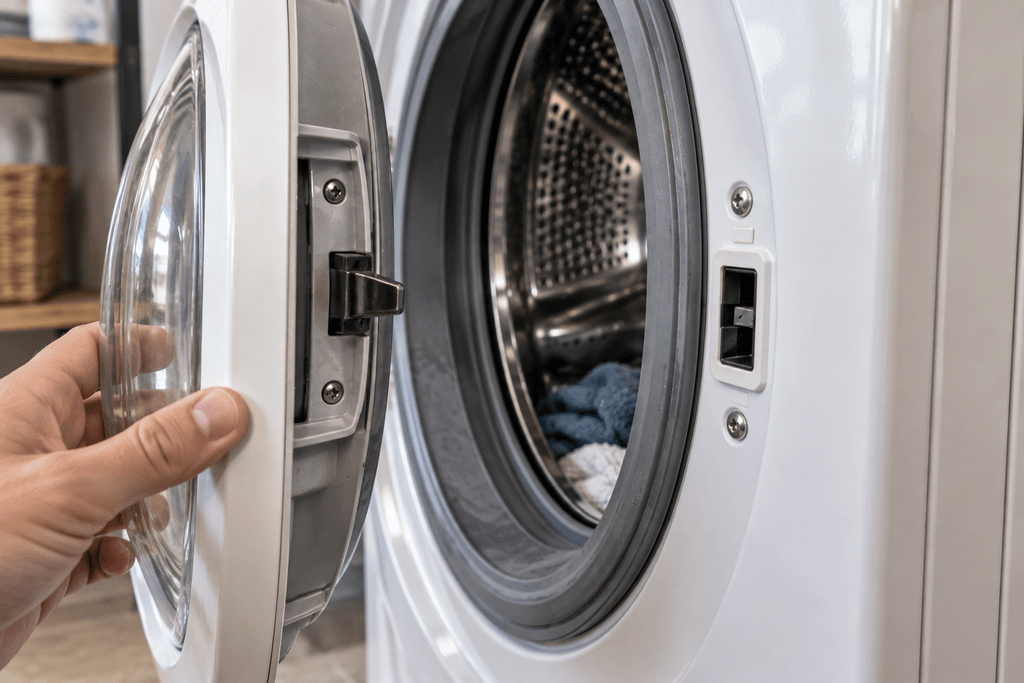
This can feel confusing because the lid or door may look completely closed. You push it in, hear a click, and still nothing happens. The issue can be mechanical or electrical. A small plastic strike on the lid may be cracked and no longer pushing the switch far enough. A front-load door latch can wear internally. Wiring leading to the lock can become loose or damaged. In some cases, the lock engages physically but fails to send the correct electrical signal to the control board.
Listen closely when starting the washer. A front-load machine often produces one or more distinct locking clicks before beginning the cycle. If you hear repeated clicking followed by an error message or complete stop, the door-lock assembly becomes a strong suspect. A top-loader may fill and wash normally but refuse to spin because the control never receives a valid “lid closed” signal.
Do not bypass the switch or defeat the safety mechanism. That advice matters because online videos sometimes suggest temporary jumper-wire tricks to make a washer run. A high-speed washing machine drum carries a tremendous amount of mechanical energy, and the locking system exists to keep that motion contained. Bypassing it can create a serious injury risk.
Homeowners can safely inspect the door or lid for obvious physical problems. Make sure clothing is not trapped between the gasket and door, check whether the latch is cracked, and remove detergent buildup around the locking area. If the mechanism looks intact but the machine still repeatedly stops, electrical testing may be needed.
A technician can test whether the lock receives power, whether its switches change state correctly, and whether the control board recognizes that signal. When a washer consistently stops right before spinning or refuses to resume after a pause, the door-lock system is one of the first places worth checking.
A washing machine cannot move from washing to spinning until it gets rid of most of the water inside the tub. That sounds obvious, but it explains why washer drainage problems are such a common reason for mid-cycle stops. The machine’s control system expects the water level to drop within a certain amount of time. If that does not happen, many washers pause, display an error, or end the cycle entirely rather than trying to spin a drum that is still full of water.
You can often recognize a drainage problem immediately because the clothes remain submerged or the bottom of a front-load drum contains standing water. The washer may hum as if something is trying to happen. You might hear the pump running continuously without much water leaving the drain hose. In other situations, the pump is completely silent because the motor has failed or is not receiving power.
Drainage problems can start in several places. Coins, hairpins, small socks, tissues, pet hair, lint, and other debris can get into the drain path. Front-load washers often have a pump filter designed to catch foreign objects before they reach the pump impeller. When that filter becomes packed with debris, drainage slows dramatically. A drain hose can also become kinked behind the machine, partially clogged internally, or installed incorrectly.
Then there is the house plumbing itself. The washer may pump water perfectly well, only for a clogged standpipe or laundry drain to back up. If water rises around the drain opening when the washer empties, the appliance may not be the true problem. In older Cleveland homes, laundry plumbing that has accumulated years of detergent residue, lint, and mineral deposits can sometimes restrict flow.
Avoid immediately assuming the pump needs replacement. A pump is only one part of the drainage system. The smartest approach is to determine whether water can physically travel from the tub, through the filter and pump, into the hose, and finally into the home’s drain.
If the washer consistently stops with water inside, do not keep forcing spin cycles. A machine that cannot drain may eventually leak, overflow during troubleshooting, or place unnecessary strain on the pump. Treat standing water as useful information. It tells you that the washer is probably stopping because the drain stage never completed successfully.
If your washer stops mid-cycle with water still inside, one of the first things to consider is a clogged drain filter or drain hose. This is especially common in households that wash pet bedding, children’s clothing, heavily soiled work clothes, or items with loose pockets. Washing machines see far more foreign objects than most homeowners realize. Coins, screws, bobby pins, tissues, lint clumps, small socks, and even tiny pieces of plastic can travel toward the pump.
Many front-load washers include an accessible drain-pump filter behind a small panel near the bottom front of the machine. Its job is to protect the pump from debris. Over time, the filter can become so restricted that water drains too slowly for the washer’s control system. The machine sees that the expected water-level change has not happened and stops the cycle.
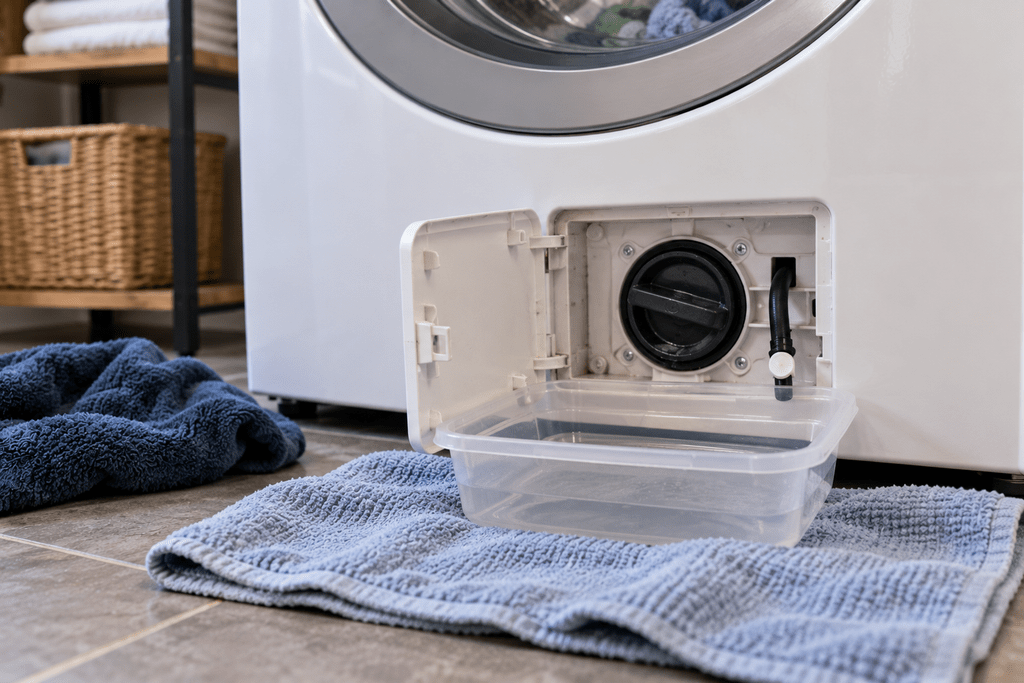
Before opening any filter, prepare for water. If the tub contains several gallons, removing the filter too quickly can send all of that water across the laundry room floor. Follow the owner’s manual, disconnect electrical power, and use the emergency drain tube if the machine provides one. Towels and a shallow pan are usually a good idea.
The drain hose deserves an inspection too. A washer pushed too close to the wall can kink the hose and restrict water flow. The hose can also become clogged internally. Installation matters as well. If the hose is shoved too deeply into the standpipe or installed at the wrong height, siphoning and drainage problems can occur.
Cleveland basement laundry setups can make this particularly easy to overlook. A washer may have been moved during remodeling, plumbing work, or floor cleaning, leaving the drain hose pinched behind it. The machine works at first but begins stopping once enough restriction develops.
If you clean the filter and straighten the hose but the washer still cannot drain, the problem may be farther downstream. A blocked household drain, failing pump, damaged impeller, pressure-sensor issue, or electrical fault can produce the same symptom.
The important lesson is simple: slow drainage can stop a washer just as effectively as no drainage at all. The machine does not know that water is “eventually” leaving. It only knows that the tub did not empty within the expected time.
The drain pump is the component that physically pushes wastewater out of the washing machine. When it starts failing, the washer may complete the wash portion perfectly but become stuck as soon as the control system commands a drain. You may hear a humming sound with little or no water movement, an unusual grinding noise, or complete silence. In some cases, the pump works intermittently, which makes the problem even harder to pin down.
Intermittent pump failures are frustrating because restarting the washer may appear to fix everything. The pump cools, starts again, and the machine completes the cycle. A few loads later, the exact same problem returns. That pattern can happen when a pump motor is weakening or overheating. Foreign objects caught around the impeller can create similar symptoms. The pump may turn sometimes but jam when the object shifts into the wrong position.
A damaged impeller is another possibility. The pump motor may run, but the internal blades that move water are cracked, loose, or stripped. From outside the appliance, it sounds like the washer is draining normally, yet very little water actually leaves.
Professional diagnosis becomes helpful because a drainage error does not automatically prove the pump itself is bad. A technician can inspect the complete drain path, test the pump electrically, verify that the control is sending power, and confirm whether the water-level system recognizes successful drainage.
If you notice a burning smell, loud grinding, or leaking from the pump area, stop using the machine until it is checked. A minor drainage issue is one thing; an overheating electrical motor or active leak is another.
Replacing a drain pump is often a reasonable repair compared with replacing an otherwise healthy washer, especially when the machine is not very old. The key is verifying the failure first. A new pump will not solve a clogged standpipe or crushed drain hose.
When a washer consistently washes normally but stops every time it needs to empty, the drain pump is one of the components that deserves serious attention. The appliance is essentially saying, “I cannot move to the next stage because I still have water where it should not be.”
Sometimes the washing machine is not failing at all. It is protecting itself from a load that has become badly unbalanced. Modern washers use vibration and speed information to determine whether the drum can safely accelerate into a high-speed spin. If a heavy load collects on one side, the machine may stop, tumble slowly, add water, drain again, or repeatedly attempt to redistribute the clothes.
This happens frequently with bulky items. Think about washing a single comforter, bathroom rug, heavy hoodie, or waterproof mattress cover. Once saturated, one item can become surprisingly heavy. If it sticks to one side of the drum, the imbalance creates huge forces as the washer spins. The machine’s suspension system tries to control that motion, but the electronic controls may stop the cycle before the washer begins banging violently against the cabinet.
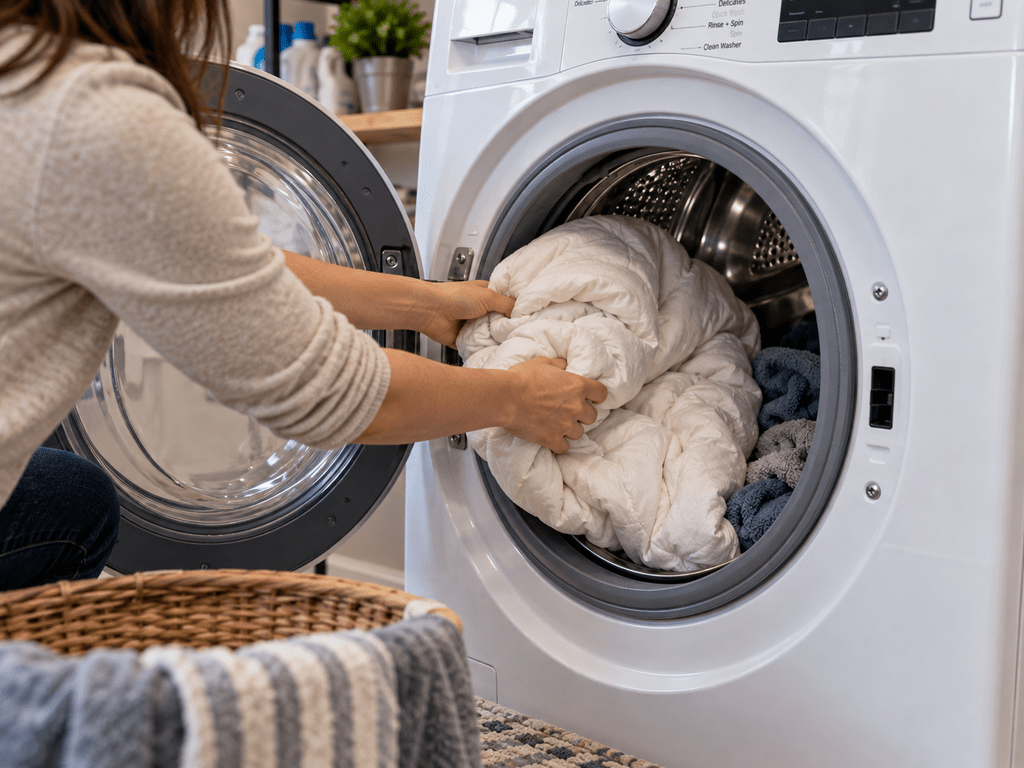
Overloading creates a related problem. Stuffing the drum tightly may seem efficient because you get more laundry done in one load, but clothes need room to move. A packed drum may not distribute items evenly, detergent may not rinse properly, and the motor can face more mechanical resistance. In severe cases, the machine may stop during agitation or spin.
The fix may be as simple as opening the washer after it unlocks, redistributing the load, and removing a few heavy items. With top-load machines, avoid wrapping sheets or blankets around the agitator. With front-loaders, mix large and small items so one heavy piece does not dominate the entire drum.
If the washer reports imbalance errors even with normal loads, however, the issue may be mechanical. Worn shock absorbers, suspension rods, springs, bearings, or a damaged tub support can allow excessive movement. An unlevel washer can also contribute. All four feet should sit firmly on the floor without rocking.
Cleveland homes with older basement floors sometimes present a special challenge because concrete may slope toward a floor drain. A washer sitting on that slope can be perfectly functional yet struggle to control high-speed spin.
One occasional imbalance is normal. Repeated mid-cycle stops with everyday loads are not. If you constantly have to rearrange clothing just to finish a cycle, the suspension or installation deserves a closer look.
A washing machine needs the right amount of water at several points during a cycle, not just at the beginning. Many machines fill once for washing, drain, and then fill again for one or more rinse stages. If the water supply fails halfway through the process, the washer may appear to “randomly” stop even though the real problem is that it is waiting for water that never arrives.
Start with the simple things. Both hot and cold supply valves should normally be fully open unless the manufacturer’s instructions specify otherwise. A kinked inlet hose can restrict flow, especially if the machine has recently been moved. Small filter screens where the hoses connect to the washer can also collect rust, sediment, or mineral deposits.
This is especially relevant in older homes where plumbing work can loosen debris inside supply lines. After a water shutoff, pipe repair, or municipal work, small particles may move through the system and end up trapped in the washer’s inlet screens.
The water inlet valve itself can fail too. This electrically controlled component opens when the washer requests hot or cold water. One side may work while the other does not. That creates strange symptoms. The washer might fill normally for a cold wash but stop during a warm rinse, or the opposite.
Low household water pressure can also slow filling enough to trigger an error. If several fixtures suddenly have weaker flow than usual, check the broader plumbing situation rather than focusing only on the washer.
Do not remove inlet screens permanently in an attempt to improve water flow. They protect the valve from debris. If cleaning is allowed for your model, follow the manufacturer’s procedure carefully and shut off the water supply first.
A washer that pauses during filling often gives you an audible clue. You may hear a faint valve hum without the normal rush of water. You might also notice that one temperature setting works while another consistently fails.
If the water supply to the machine is good but filling remains unreliable, professional testing can determine whether the inlet valve, pressure sensor, wiring, or control board is responsible. The washer cannot continue its programmed cycle if it never receives the amount of water it expects.
The washer’s drive system does the heavy physical work of moving a tub full of wet clothing. Depending on the design, that system may include an electric motor, belt, pulley, coupler, clutch, transmission components, or a direct-drive assembly. If something in that chain begins slipping, overheating, or failing, the washer may stop mid-cycle even though it still has power.
The exact symptoms depend on the design. A broken belt may leave the motor running while the drum does not move. A worn belt may slip under heavy loads but work normally with lighter ones. A failing motor coupler on certain top-load designs can interrupt agitation or spinning. Some direct-drive machines rely on electronic motor control rather than traditional belts, creating a different set of possible faults.
Listen for changes. A washer that previously operated quietly but suddenly produces squealing, grinding, humming, or repeated attempts to start deserves attention. A burning rubber smell can suggest a slipping belt. A hot electrical smell may indicate a motor or wiring issue. If the drum feels unusually difficult to rotate by hand when the washer is empty and unplugged, bearings or mechanical components may be binding.
Motors also have thermal protection. If a motor overheats, an internal protector can shut it down until it cools. The washer may stop halfway through a heavy load, appear dead for a while, and then work again later. That temporary recovery does not mean the problem has disappeared. It may indicate excessive mechanical load, a failing motor, restricted movement, or another issue causing overheating.
Drive-system diagnosis is one area where guessing gets expensive. Replacing a belt will not fix a seized bearing. Replacing a motor will not fix a control board that fails to power it correctly.
A technician can inspect mechanical wear, test motor windings and control signals, and determine whether the failure occurs only under load. That distinction is important because a washer can appear perfectly normal when empty yet fail as soon as several gallons of water and 15 pounds of wet laundry create real resistance.
If the washer stops during agitation or spin and you hear abnormal mechanical sounds, the drive system deserves a serious look.
Older washing machines often use a mechanical timer to advance from one stage to the next. Newer machines rely on electronic control boards, sensors, relays, and software. Both systems perform the same basic job: they tell every component when to start, when to stop, and what should happen next. When the control system fails, the washer can become stuck at one point in the cycle even though individual mechanical parts are still functional.
A failing mechanical timer may stop at the same position every time. You may find that manually turning the knob slightly allows the cycle to continue. That pattern can indicate worn internal timer contacts or a failing timer motor.
Electronic problems tend to be less predictable. The display may freeze, buttons may stop responding, error codes may appear, or the washer may suddenly reset. In some cases, the control board works normally until it warms up, then develops intermittent faults. After the appliance sits for a while, it starts working again.
Power surges can contribute to electronic control problems. Washing machines contain sensitive circuits, and although modern boards include protection, they are not immune to voltage irregularities. A lightning event, utility issue, or electrical problem inside the home can damage components. Cleveland homeowners who have experienced similar appliance problems after an outage can also read about appliance problems after a Cleveland power outage.
However, do not blame the control board too quickly. Electronic boards are often among the more expensive parts in a washer, and many other failures can make the board appear guilty. If the control is waiting for a door-lock signal, water-level change, or drain confirmation that never arrives, the cycle will stop even though the board is functioning exactly as designed.
This is why proper diagnosis matters. A technician may test sensors, switches, wiring, and loads before condemning the main control. The board should usually be the conclusion of a troubleshooting process, not the starting assumption.
If your washer repeatedly freezes at exactly the same point with no obvious drainage, water, load, or door-lock problem, the timer or control system becomes more likely. Likewise, a blank or flickering display combined with intermittent operation can point toward an electronic issue.
A control problem can make a perfectly good washer behave as if multiple systems are failing at once. The challenge is separating a bad decision-maker from a good decision-maker responding to bad information.
A washing machine that suddenly loses power in the middle of a cycle may have a problem outside the washer as well as inside it. Start with the basics: check whether the display is completely dead or whether the machine is merely paused. If there is no power at all, inspect the circuit breaker and outlet without repeatedly resetting anything that continues to trip.
A tripped breaker is information, not an inconvenience to be defeated. If the breaker trips again as soon as the washer starts or reaches a particular stage, something may be drawing excessive current or creating a short circuit. Motors, pumps, heaters on some models, wiring harnesses, and control boards can all cause electrical faults.
Loose outlet connections are another concern, particularly in older homes. Washing machines draw significant current during motor startup and high-speed spin. A weak connection may heat under load and eventually interrupt power. Any discoloration, melting, burning smell, or unusual warmth around the receptacle should be treated seriously.
Extension cords and lightweight power strips should not be used for washing machines unless the manufacturer specifically permits an appropriate setup. The appliance should generally be connected according to its installation instructions and local electrical requirements.
Overheating inside the washer can also produce a mid-cycle shutdown. Motors often include thermal protection, and electronic controls may monitor temperature. If a component gets too hot, the machine may stop until it cools. That can create a very specific pattern: the washer runs normally when cold, stops after 20 or 30 minutes, then works again later.
Repeated overheating is not normal. Something is creating excess electrical or mechanical load. A tight bearing, failing pump, overloaded drum, weak motor, blocked cooling path, or electrical fault could be responsible.
If you smell burning insulation, see sparks, hear electrical buzzing, or experience repeated breaker trips, stop using the machine until the cause is identified. Water and electricity make a bad combination, and washers operate in an environment where leaks are always possible.
Basic power checks are reasonable for homeowners. Opening electrical panels and testing live appliance circuits is a job for someone with the correct training and equipment.
A washing machine lives indoors, but Cleveland’s climate and housing stock can still influence how reliably it operates. Many local homes place laundry equipment in basements, utility rooms, garages, or older additions where temperature, plumbing, drainage, and electrical conditions differ from the main living space.
Winter creates some obvious problems. Cleveland cold can affect supply lines in poorly insulated areas, particularly near exterior walls. A partially frozen or severely chilled water line may reduce flow enough that the washer cannot fill within its programmed time. Modern machines may stop and display an inlet error rather than waiting forever.
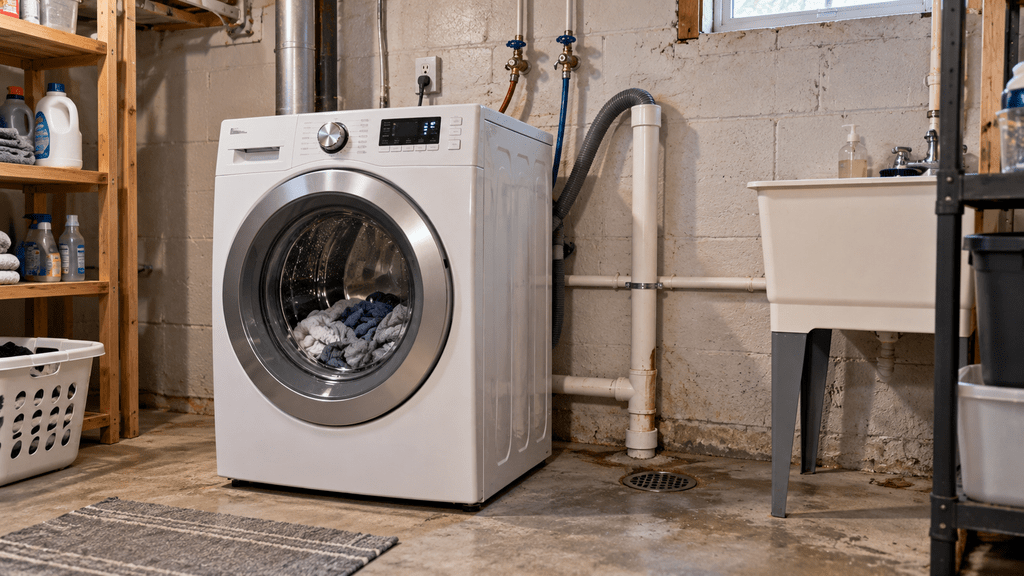
Basement drainage is another factor. Older homes may have laundry standpipes or utility sinks connected to plumbing that has accumulated decades of lint, soap residue, and mineral deposits. The washer’s pump can be perfectly healthy while the household drain cannot accept water quickly enough. The result may be slow drainage, backups, or mid-cycle errors.
Humidity also matters, although usually indirectly. Damp basement environments can contribute to corrosion around connectors, electrical terminals, and metal components over many years. Front-load washers in humid spaces may also develop more residue around door seals and detergent systems if they are not allowed to dry between loads.
Floor conditions are surprisingly important too. Many basement floors slope toward drains. A washer that is not properly leveled may experience excessive vibration during spin. Newer machines can detect that movement and interrupt or reduce spin speed, leaving clothes wetter than expected.
Older electrical systems deserve consideration as well. A laundry circuit that was acceptable decades ago may now be serving additional equipment or may have aging connections. Intermittent voltage drops, loose receptacles, or overloaded circuits can create symptoms that look like appliance failure. These conditions are also discussed in more detail in our guide to appliance problems in older Cleveland homes.
None of this means Cleveland is unusually hard on washing machines. It simply means the environment around the appliance should be part of the diagnosis. If a washer works perfectly in summer but struggles during extreme cold, look beyond the machine itself. If it stops only during drain cycles and the basement standpipe overflows, the plumbing may be responsible.
Good appliance troubleshooting considers the whole installation: water in, water out, stable power, solid flooring, and proper room conditions. Cleveland homeowners dealing with appliance problems related to basement or seasonal conditions can also learn more about how Cleveland weather affects garage and basement appliances.
Before calling an appliance technician, you can perform several safe checks that may solve the problem or at least make the diagnosis faster. First, note exactly where the washer stops. Does it fail during filling, washing, draining, rinsing, or spinning? That one detail is incredibly useful.
Check the display for an error code and write it down before unplugging or resetting the machine. If you have the owner’s manual, look up what system the code refers to. Remember that the code identifies where the washer noticed trouble, not necessarily the exact failed part.
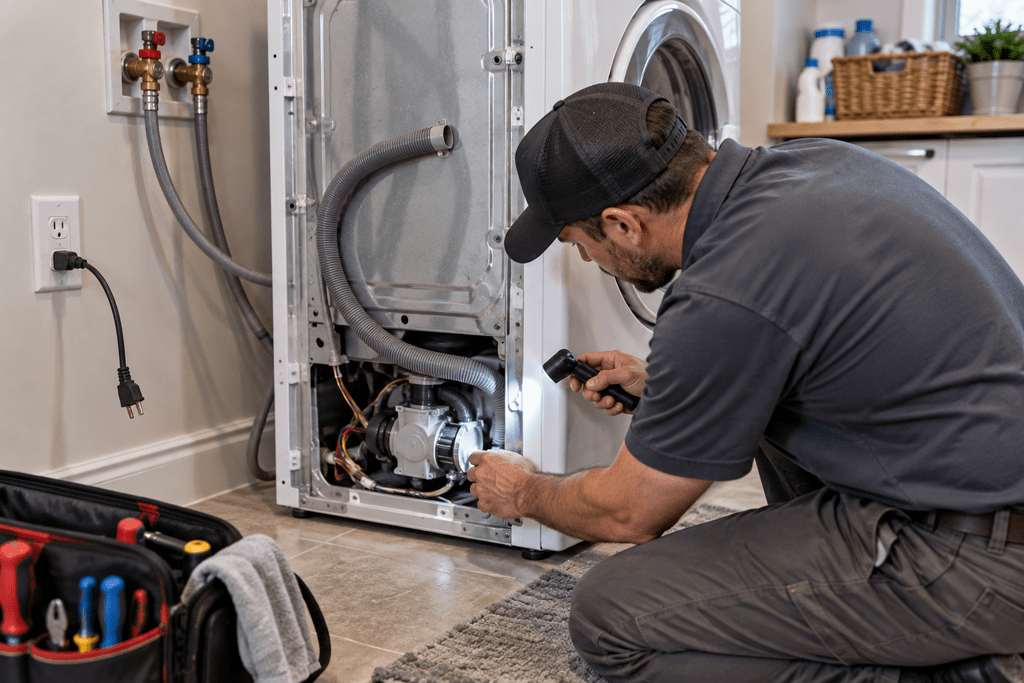
If the tub contains water, inspect accessible drain components according to the manufacturer’s instructions. Check the hose for kinks and look for signs that the household drain is backing up. For front-load models with a user-serviceable pump filter, prepare carefully for water before opening it.
If the machine stops before spin, make sure the door or lid closes properly. Look for clothing caught in the door gasket and inspect the latch area for visible damage. Redistribute heavy or bulky loads and verify that the washer sits firmly on the floor without rocking.
For filling problems, confirm that water valves are open and hoses are not crushed. If other faucets in the home have unusually low pressure, the problem may extend beyond the washer.
Call for professional washer repair when the machine repeatedly stops in the same place despite these basic checks, especially if you hear grinding, smell burning, see leaks, experience breaker trips, or cannot safely drain the tub. Professional service is also appropriate when the problem involves internal wiring, motors, pumps, control boards, door-lock circuits, or gas-powered combination appliances.
Give the technician useful details: brand, model number, approximate age, error code, stage of the cycle where the washer stops, and any unusual noise or smell. That information can shorten diagnostic time.
Most importantly, avoid replacing random parts. A mid-cycle stop is a symptom shared by many failures. Correct diagnosis saves money because it identifies what interrupted the sequence rather than simply replacing the component that seems most obvious.
A washing machine that stops halfway through a load is frustrating, but the moment it stops usually tells you something valuable. Washing machines operate in a carefully controlled sequence, and when one step does not finish correctly, the machine often refuses to continue. That behavior is annoying when you are staring at a tub full of wet towels, but it also protects the appliance from operating under unsafe or damaging conditions.
The most common causes are often easier to understand once you think about what the washer was trying to do. If it stops before draining, inspect the drain system. If it stops before spinning, think about the door lock, lid switch, load balance, suspension, or drive system. If it stops while filling, look at water supply and inlet components. A complete power loss brings electrical problems higher on the list.
Cleveland homeowners should also pay attention to the environment around the washer. Basement drains, sloped floors, cold supply lines, older plumbing, and aging electrical systems can all contribute to symptoms that look like appliance failure.
Some fixes are simple. Redistributing a comforter, cleaning an accessible pump filter, straightening a kinked hose, or fully opening a water valve may get the washer running normally again. Other situations require testing equipment and experience.
If the washer repeatedly stops, leaks water, smells hot or burned, trips a breaker, makes grinding noises, or displays the same error after basic troubleshooting, professional service is the sensible next move. If you need professional help in the area, appliance repair in Cleveland can help with washer problems that require proper diagnosis. Continuing to restart a machine without understanding the cause can turn a manageable repair into a more expensive one.
Your washer does not stop in the middle of a cycle just to ruin laundry day. Something prevented it from completing the next step. Find that missing step, and you are usually much closer to finding the real problem.
We repair a wide range of household appliances including refrigerators, washers, dryers, ovens, dishwashers, and more. No matter the brand or model, our experienced technicians are ready to help. We repair commercial appliances as well: commercial washers dryers, commercial refrigerators & freezer & more.
We service a wide range of household appliances, including refrigerators, dryers, washers, ranges, cooktops, dishwashers, freezers, ice makers, ovens, and double ovens.
Our technicians operate across many locations in Ohio, covering major cities like Cleveland, Akron, and Parma. We also serve surrounding areas including Lakewood, Westlake, Strongsville, and Brooklyn.
Our service area extends to Rocky River, Euclid, Solon, Beachwood, and Cleveland Heights, as well as counties such as Cuyahoga, Lorain, Lake, and Medina.
Additional cities we cover include North Olmsted, North Ridgeville, Valley City, Lorain, Avon Lake, Richfield, Brecksville, Garfield Heights, Seven Hills, Brunswick, Oakwood, Mentor, and Willoughby.