Appliance Problems After a Cleveland Power Outage
Published: August 3, 2026
Hard water is one of those household problems that rarely kicks down the door and announces itself. It works quietly. A faint white film appears on a drinking glass, the dishwasher needs a second cycle, or freshly washed towels begin feeling rougher than they used to. You might blame the detergent, the appliance brand, or the way someone loaded the machine. Sometimes those explanations are correct, but mineral-heavy water may be the real troublemaker hiding in plain sight.
For Cleveland homeowners, water conditions can vary depending on the local supply, treatment process, neighborhood infrastructure, and even the plumbing inside an individual home. The water does not need to be extremely hard to create appliance problems. Moderate amounts of dissolved calcium and magnesium can leave deposits after hundreds of wash cycles. Think of it like a thin layer of dust landing on a shelf every day. One day’s dust does not matter much, but ignore it for a year and the surface tells a very different story.
Dishwashers and washing machines are especially vulnerable because they repeatedly combine water, heat, detergent, pumps, valves, sensors, and narrow passageways. Every cycle gives dissolved minerals another opportunity to settle on an internal surface. Deposits can restrict water flow, insulate heating elements, interfere with sensors, reduce detergent performance, and force motors or pumps to work harder. The appliance may continue running, but “running” and “working correctly” are not the same thing.If your dishwasher continues showing these symptoms, professional dishwasher repair can help determine whether mineral buildup or a failing component is responsible.
The frustrating part is that hard-water damage can resemble ordinary appliance failure. A dishwasher with clogged spray holes may look as though it has a weak circulation pump. A washer with restricted inlet screens may display a fill error that suggests a bad valve. A heating element covered in scale may take longer to warm water, making the entire cycle feel slow and ineffective.
Understanding how mineral deposits develop helps you catch the problem early. It also keeps you from treating every cloudy glass or slow-fill error as an isolated annoyance. Hard water is not just a cleaning issue. Over time, it can become a mechanical, electrical, and financial issue as well.
Hard water contains dissolved minerals, primarily calcium and magnesium. These minerals are not usually visible when the water comes from the faucet. The water may look clear, smell normal, and taste perfectly acceptable. The trouble begins when that water is heated, evaporates, or mixes with detergents. Under those conditions, some of the dissolved material can separate from the water and attach itself to appliance components.
Inside a dishwasher, mineral deposits may develop on spray arms, filters, heating elements, stainless-steel surfaces, pumps, water-level sensors, and the walls of narrow internal channels. Inside a washing machine, buildup can affect inlet screens, valves, detergent dispensers, heating systems, drums, outer tubs, hoses, pumps, and seals. You rarely see the most serious deposits because they are hidden behind panels or inside plumbing pathways.
Scale is hard and crusty. Soap scum is different, although the two often appear together. Hard-water minerals react with soap and detergent ingredients, creating residue that sticks to surfaces and fabric. This can make homeowners add more detergent, believing the machine is not receiving enough cleaning product. That reaction often makes the problem worse because excess detergent leaves additional residue, traps soil, and encourages odor-producing buildup.
Imagine trying to breathe through a drinking straw that becomes slightly narrower each week. At first, you barely notice. Eventually, you must work much harder to pull through the same amount of air. Appliance valves, pumps, and spray systems face a similar problem when mineral deposits gradually reduce their openings. The motor or pump may still operate, but the flow it produces becomes weaker.
This is why hard-water damage tends to develop slowly. There may be no dramatic breakdown on the first day or even during the first year. Performance simply declines. Cycles take longer, dishes need rewashing, laundry feels different, and the appliance uses more energy to produce worse results. By the time a component fails completely, the mineral buildup may have been influencing the machine for months.
Water collects minerals naturally as it moves through soil, rock, underground formations, reservoirs, and distribution systems. Calcium and magnesium dissolve into the water along the way. Municipal treatment makes water safe to distribute and use, but it does not always remove every hardness mineral. The amount that reaches a Cleveland home can vary, and the plumbing inside the property may add its own layer of complexity.
Older pipes can release particles that settle in appliance inlet screens and valves. Older plumbing systems can also contribute to appliance problems. Learn why this is common in our article about appliance repair challenges in older Cleveland homes. Plumbing repairs may disturb sediment inside supply lines. Water heaters can collect mineral deposits and send some of that debris downstream. A newly installed appliance connected to older household plumbing may therefore receive more than clean-looking water. The machine could be brand new while the water path serving it has decades of history.
Hardness is usually measured in grains per gallon or milligrams per liter as calcium carbonate. Homeowners do not need to memorize a chemistry chart, but they should understand that “hard” is not an all-or-nothing label. Water can be slightly hard, moderately hard, hard, or very hard. Even a middle-range result can cause visible film and internal scale when water is heated repeatedly.
You may also notice that the problem differs between hot and cold fixtures. Hot water tends to reveal mineral issues more clearly because heat encourages deposits to form. That is one reason scale often appears around showerheads, faucets, coffee makers, water heaters, dishwashers, and washing-machine components that use warm or hot cycles.
A basic hardness test strip can provide a useful starting point. More detailed testing is available through water-treatment professionals or laboratories. Before buying expensive equipment, however, confirm what you are actually dealing with. White residue can come from hardness minerals, but cloudy dishes may also result from excess detergent, poor rinsing, damaged glass, low water temperature, or a malfunctioning dishwasher.
The important point is that water quality and appliance condition are connected. When mineral deposits repeatedly appear on fixtures, shower doors, kettles, and glassware, the same process is probably occurring inside water-using appliances—even where you cannot see it.
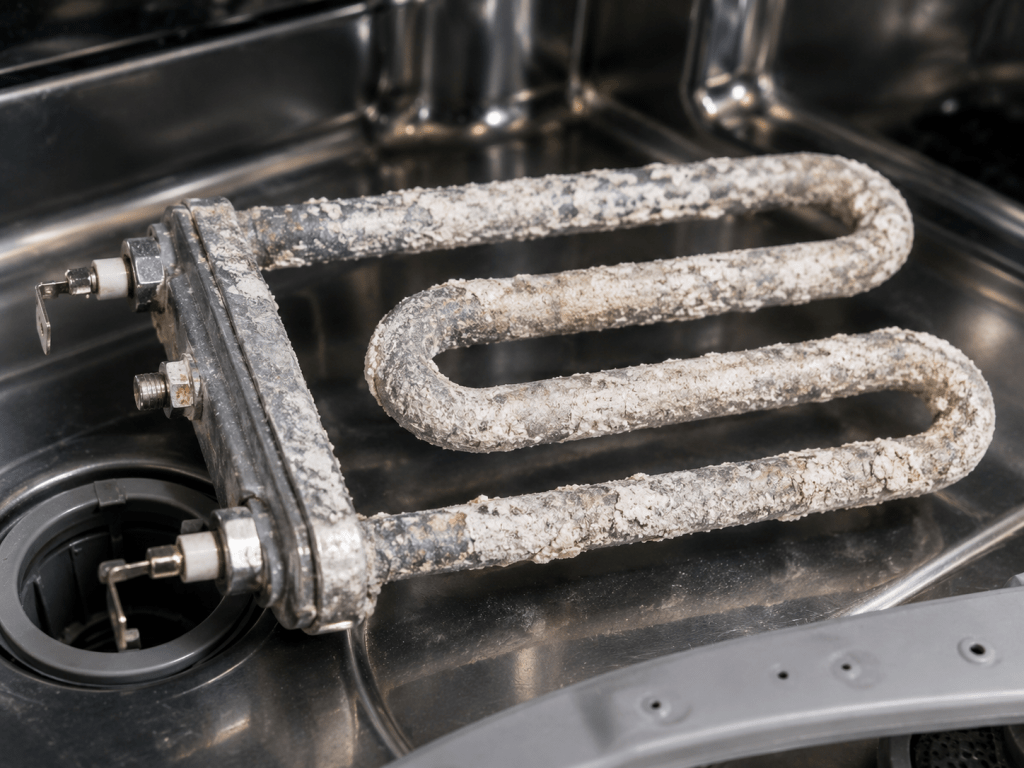
Heat changes the behavior of dissolved minerals. As water temperature rises, certain mineral compounds become less likely to remain dissolved. They separate from the water and attach to nearby surfaces, especially hot metal components. That is why a heating element often becomes one of the first places where serious scale develops.
Picture a clean electric heating element surrounded by water. The element transfers heat directly into that water, allowing the appliance to reach the required temperature efficiently. Now imagine wrapping that element in a rough mineral shell. The scale acts like an insulating blanket. The element must remain energized longer and may operate at a higher internal temperature to deliver the same amount of heat.
That extra stress can shorten component life. A dishwasher may take longer to heat wash water or dry dishes. A washing machine with an internal heater may struggle to maintain a sanitizing or high-temperature cycle. Sensors may report that the target temperature has not been reached, causing longer cycle times or error codes. The homeowner sees a slow appliance, but the machine is really fighting through a layer of mineral insulation.
Heat also speeds up evaporation. During a dishwasher’s drying phase, water left on dishes and interior surfaces evaporates, but the minerals do not evaporate with it. They stay behind as a white or gray film. The same thing happens around washer dispensers, door glass, and areas where small amounts of water repeatedly dry.
Using hotter settings is not always the answer to poor cleaning. When hard water is involved, turning up the temperature without addressing mineral buildup may accelerate scale formation. The machine might clean slightly better for a while, but the internal deposits continue growing.
This does not mean homeowners should avoid all hot cycles. Hot water serves important cleaning and sanitation purposes. The better strategy is to control detergent amounts, maintain the appliance, monitor water hardness, and descale appropriate components before buildup becomes severe. Heat is not the villain by itself. It simply acts like a spotlight, making the existing mineral problem much easier to see.
A dishwasher depends on precise water movement. It fills with a measured amount of water, heats that water, circulates it through narrow spray openings, filters out food particles, drains the dirty water, and repeats parts of the process. Hard-water deposits can interfere with nearly every stage.
The fill valve may open correctly but deliver less water because its inlet screen is restricted. Spray-arm holes may become partially blocked, reducing pressure and changing the spray pattern. Scale can coat the heating element, making water heating and drying less efficient. Mineral film can confuse optical or turbidity sensors that help the dishwasher decide how dirty the water is. Pumps may operate longer because the machine is not cleaning effectively during the first pass.
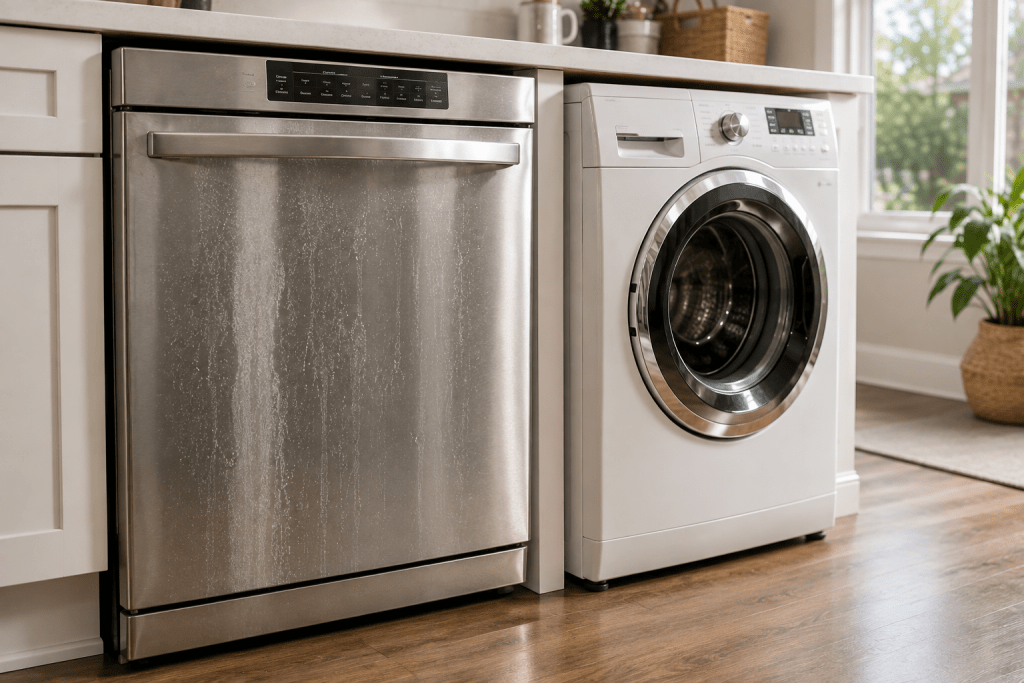
The homeowner usually notices the results before the mechanical problem. Dishes come out with spots. Glasses look foggy. Flatware develops a chalky coating. Plastic containers remain greasy. Detergent sticks inside the dispenser or forms a lump at the bottom of the tub. The natural response is to use more detergent or select a heavier cycle, but that can increase residue and operating time without restoring water flow.
Hard water can also affect stainless-steel interiors. The tub itself may not be damaged immediately, but mineral film can trap food soil and create a dull, dirty appearance. Around filters and door edges, the residue may combine with grease into a stubborn coating. Odors can develop because food particles cling more easily to rough, dirty surfaces than to clean ones.
A dishwasher with mineral buildup often becomes louder. Pumps may strain, spray arms may rotate unevenly, and water may strike dishes in an abnormal pattern. These sounds can be mistaken for a failing motor. Sometimes the motor really is wearing out, but the underlying mineral restriction may have contributed to that wear.
Good diagnosis looks at the entire water path. Replacing a pump without checking fill volume, spray arms, filters, and scale could restore only part of the performance. The goal is not simply to make the dishwasher run. It is to make sure water reaches the dishes with the pressure, temperature, and detergent balance the machine was designed to use.
Cloudy glassware is one of the most common signs homeowners associate with hard water, but not all cloudiness is the same. Mineral film usually sits on the surface and may improve when treated with an appropriate acidic cleaner. Permanent etching is actual damage to the glass. It creates a hazy appearance that cannot be wiped away because the surface itself has changed.
Hard water promotes mineral film because droplets dry on the glass and leave dissolved solids behind. If the dishwasher lacks rinse aid, has a poorly adjusted dispenser, or does not reach the correct rinse temperature, the film may become more obvious. Excess detergent can add another layer. Homeowners often assume that more detergent means cleaner dishes, but hard water requires balance rather than guesswork.
Too little detergent may fail to bind minerals and remove food soil. Too much can leave its own residue, especially when the machine uses less water than older dishwashers did. Modern high-efficiency dishwashers are designed around carefully measured chemistry. Throwing in an oversized detergent pod plus extra powder can be like adding twice the recommended soap to a washing machine: dramatic foam does not guarantee better cleaning.
Rinse aid helps water spread into a thin sheet rather than forming beads. Fewer droplets mean fewer concentrated mineral spots. It can improve drying and reduce visible residue, although it does not remove existing scale from pumps or heating elements. Adjusting the rinse-aid setting may help during humid Cleveland summers, when drying conditions can already be more challenging.
Check whether the cloudy film appears on everything or mostly on glass. If plates, flatware, and the dishwasher walls also have a chalky coating, mineral residue is likely. If only delicate glassware looks permanently hazy, etching may be involved. Very soft water, excessive detergent, and high temperatures can contribute to etching, so installing a softener does not mean you should continue using the same detergent amount.
Cloudy glass is not just a cosmetic annoyance. It is an early message from the machine. When visible residue is forming on dishes, deposits may also be developing on components you cannot see.
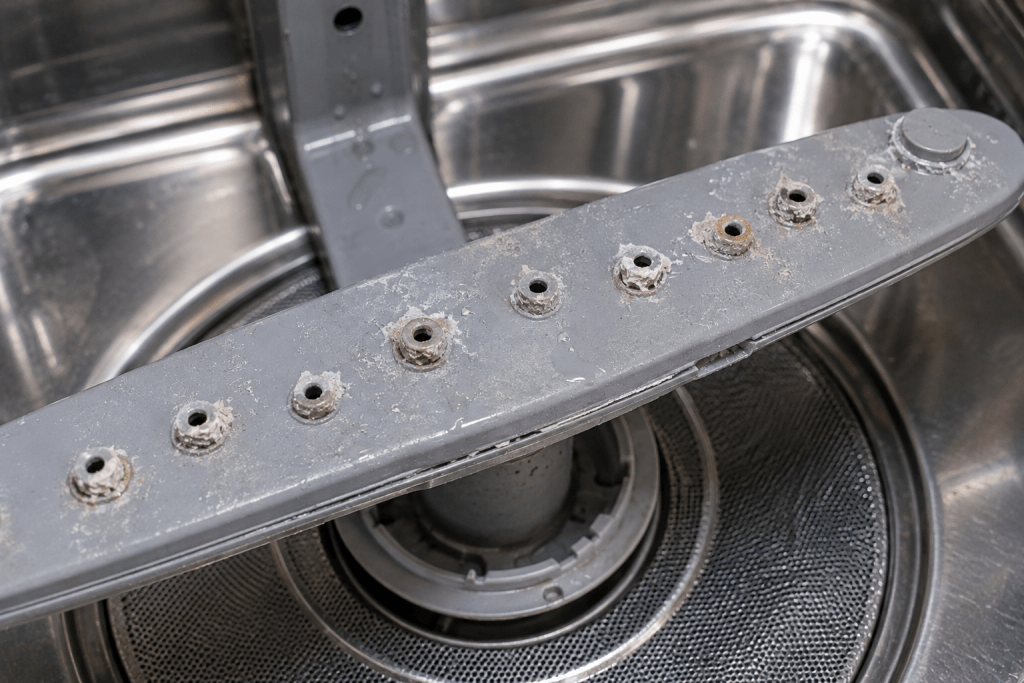
Dishwasher spray arms work like rotating lawn sprinklers inside a sealed box. Water enters under pressure, exits through carefully positioned openings, and creates the force that turns the arm. Each small hole has a job. Some aim upward, some reach corners, and others provide the thrust needed for rotation.
Hard-water scale can narrow those openings. Food particles can then stick to the rough mineral surface, making the restriction worse. One blocked jet might leave a few dishes dirty. Several partially blocked jets can weaken the entire wash pattern, allowing the spray arm to rotate slowly or stop in one position.
You can often spot this problem by examining removable spray arms according to the owner’s manual. Look for white crust around the holes, trapped seeds, labels, bone fragments, or pieces of broken glass. Do not force metal objects deeply into the openings because you may enlarge or damage them. A spray hole that changes size can alter the pressure balance and keep the arm from rotating correctly.
The spray-arm bearings or mounting points can also collect deposits. An arm may look clean but feel stiff when turned by hand. If it cannot rotate freely, dishes in certain zones will consistently remain dirty. Homeowners sometimes blame the loading pattern, but the real issue is that the arm no longer sweeps across the full rack.
Mineral buildup in the circulation system can reduce pressure before water even reaches the spray arm. The pump housing, filter area, diverter assembly, and internal tubing may all be affected. Cleaning the visible holes helps only when the deeper water path remains healthy.
A useful test is to position the spray arms in a known direction before starting a short cycle. After the machine has circulated water, pause it safely and check whether the arms moved. This does not measure pressure or diagnose the pump, but it can reveal an obvious rotation problem.
When spray performance declines, cleaning quality usually drops gradually. That slow change is why people adapt by pre-rinsing dishes or running longer cycles. A properly functioning dishwasher should not need you to become its unpaid assistant.
The heating element is one of the dishwasher components most vulnerable to scale. Mineral deposits form a hard coating that reduces heat transfer. The element may stay on longer to achieve the target temperature, increasing energy use and internal stress. In severe cases, the element can overheat or develop a failure beneath the scale.
Circulation pumps face a different kind of strain. Their job is to move water with enough pressure to clean dishes. Scale inside the pump housing or water channels can reduce flow, while mineral debris may interfere with impellers and seals. A pump that must work longer during every cycle may become noisy, leak, or fail earlier than expected.
Drain pumps can also suffer. Hard-water deposits combine with grease, detergent residue, and food particles to create a rough buildup around filters and drain passages. The machine may leave water in the tub, display a drainage error, or produce a humming sound. Replacing the pump without clearing the restriction can lead to another failure.
Sensors are easy to overlook because they do not appear mechanically worn. Some dishwashers use sensors to evaluate water clarity, temperature, fill level, or pressure. Mineral film can interfere with their readings. A dirty sensor may tell the control system that the water remains heavily soiled, causing longer wash cycles. Another sensor may fail to detect the correct water condition and trigger an error code.
The float assembly, which helps prevent overfilling on many models, can become stiff from residue. A float stuck in the raised position may make the dishwasher think it is already full, preventing normal filling. A technician could mistake the symptom for a bad inlet valve unless the float and surrounding area are checked.
These failures show why hard-water maintenance is not only about making dishes look better. Scale changes the physical conditions under which electrical and mechanical parts operate. Components become hotter, flow rates fall, seals face rougher surfaces, and controls receive inaccurate information.
When several symptoms appear together—long cycles, weak spray, poor drying, unusual noise, and visible scale—the dishwasher needs a system-level inspection. One failed part may be only the final link in a much longer chain.
Washing machines use more water than dishwashers and process a much wider range of soil. Body oils, dirt, lint, hair, detergent, fabric softener, and minerals all circulate through the machine. Hard water changes how those materials behave. It makes detergent less efficient, encourages residue, and creates deposits inside components that homeowners rarely inspect.
In a top-loading washer, mineral buildup may develop around the basket, tub ring, dispenser, water valve, pump, and internal hoses. Front-loading machines can collect it around the door glass, rubber boot, detergent drawer, heater, sump, pressure chamber, and outer tub. The shiny stainless-steel drum may look clean while a thick residue layer develops behind it.
Poor detergent performance is often the first sign. Hardness minerals react with detergent ingredients, leaving less cleaning power available for soil and stains. Clothes may look dull, smell less fresh, or feel stiff after drying. White or gray residue can appear on dark fabric. The homeowner responds by adding more detergent and fabric softener, creating an even heavier coating inside the washer.
High-efficiency machines are especially sensitive to overuse of detergent because they operate with less water. The smaller water volume cannot rinse away an oversized dose. When hard water is added to the equation, the mixture can become sticky and difficult to remove. It clings to hoses, sensors, and the outer tub, providing a place for bacteria and mildew to grow.
Minerals can also affect mechanical performance. Restricted inlet flow extends fill times. Pressure-sensing pathways may become coated. Heating elements work less efficiently. Pump impellers may collect debris. Seals can wear against rough deposits. None of these changes happens overnight, but each cycle adds a tiny amount of stress.
A washing machine should clean clothing, not slowly coat it. If mineral buildup has already affected your washer’s performance, professional washer repair may help prevent additional component damage. When laundry quality declines despite normal cycles, the problem may involve water chemistry as much as appliance mechanics.
Every washing machine receives water through one or more electrically controlled inlet valves. Small screens near the hose connections catch sediment before it enters the valve. Those screens provide protection, but they can also become clogged by mineral particles, rust, and plumbing debris.
Restricted screens reduce the amount of water entering the machine. Older washers may take much longer to fill. Modern washers may display an error because the expected water level was not reached within a specific time. A cycle may pause, cancel, or repeatedly open the valve in an attempt to compensate.
The symptom can affect only hot or cold water. For example, the machine may fill normally on a cold cycle but struggle when a warm cycle is selected. That pattern suggests a restriction or supply issue on one side rather than a total washer failure. The household shutoff valve, hose, inlet screen, and internal valve all deserve inspection.
Hard-water deposits can form inside the valve itself, where homeowners cannot easily clean them. The solenoid may energize, but the internal passage may not open fully. In some cases, the valve begins leaking slowly even when it should be closed. Water may drip into the drum between cycles, creating a stale odor or an unexpected puddle.
Washing-machine hoses can develop restrictions too. A hose may appear normal externally while its inner lining collapses. Flood-protection hoses may close after detecting sudden flow or may become partially obstructed. Mineral debris released during plumbing work can lodge in the connection.
Before replacing an inlet valve, a technician should verify household pressure, confirm that both shutoffs open fully, inspect the screens, and measure actual fill behavior. A new washer will not fill correctly when the home’s supply valve is corroded or barely open.
Homeowners should avoid drilling, cutting, or permanently removing inlet screens. Those screens keep damaging debris out of the valve. Cleaning or replacing the correct component is safer than creating a larger opening for sediment to enter.
When the washer fills slowly, it is telling you something important. Do not simply accept longer cycle times as part of the machine’s age.
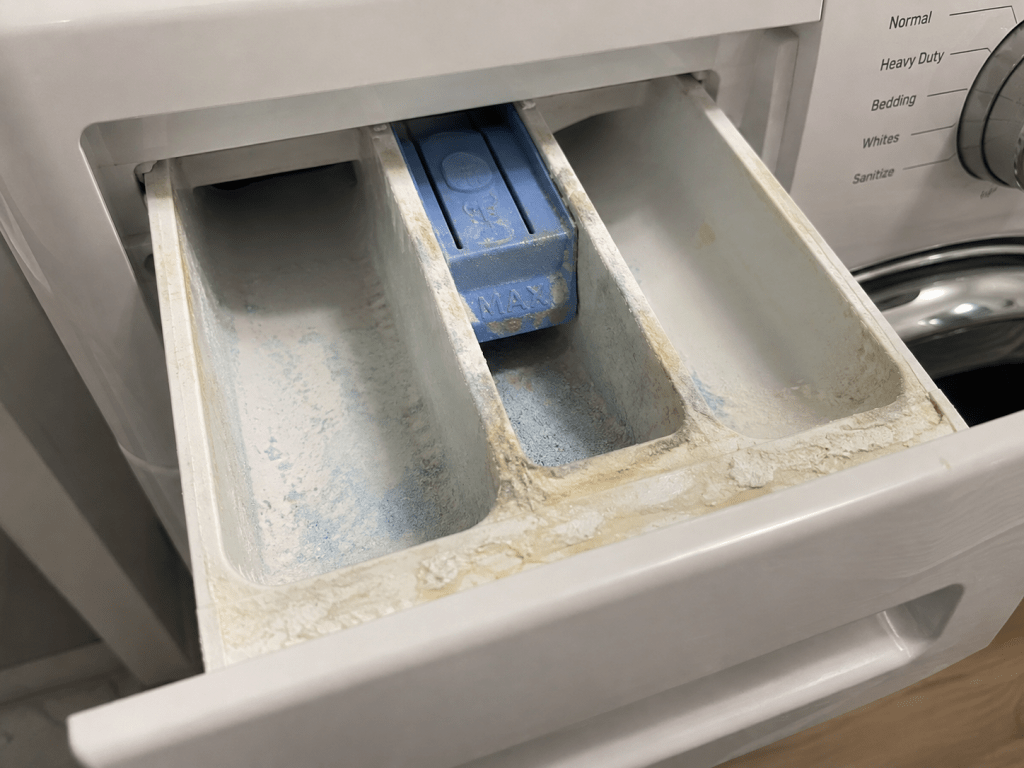
Detergent needs to dissolve, bind minerals, loosen soil, hold dirt in suspension, and rinse away. Hard water makes that job more difficult. Some of the detergent’s ingredients become occupied by calcium and magnesium instead of clothing soil. When homeowners increase the dose without considering washer type, water hardness, load size, and detergent concentration, residue begins accumulating.
That residue can make fabric feel stiff or waxy. Towels become less absorbent because detergent and fabric-softener coatings remain on the fibers. Dark clothing may show pale streaks. White clothing can turn gray or yellow over time. Fragrances may mask the issue temporarily, but perfume does not equal cleanliness.
Inside the washer, residue collects where moisture lingers. Front-loader door boots, detergent drawers, outer tubs, and drain hoses are common problem areas. Top-loaders may develop buildup beneath the agitator, around the wash plate, and between the inner basket and outer tub. Because these areas stay damp, bacteria and mildew find an ideal environment.
The result is the familiar “clean laundry that does not smell clean” problem. Clothing may smell acceptable when it leaves the machine but develop a sour odor after sitting in a closet or becoming slightly damp. Rewashing with more detergent usually makes the cycle repeat.
Correct dosing matters. Concentrated detergents require surprisingly small amounts, particularly in high-efficiency washers. Read both the detergent label and the appliance manual. The large line on a detergent cap is not automatically the right dose for every load.
Fabric softener deserves similar caution. It leaves a coating by design, and hard-water residue can make that coating heavier. Overuse may clog dispensers, trap odors, and reduce towel absorbency. Dryer sheets or alternative laundry methods may work better for some households, but no product will compensate for a washer packed with buildup.
A clean washer should smell neutral when empty. Strong fragrance, sourness, or a musty odor indicates that material remains somewhere inside. The solution is not stronger perfume. It is less residue, better rinsing, correct detergent use, and regular machine cleaning.
Not every washing machine heats its own water, but models with internal heaters can develop the same scale problems seen in dishwashers and water heaters. The mineral layer insulates the heating surface, forcing it to operate longer. High-temperature, allergen, steam, and sanitizing cycles may become slower or fail to reach the intended temperature.
The drum and outer tub also collect deposits. In a front-loader, you may see a chalky ring around the door glass or stainless-steel basket. The more serious buildup may sit behind the drum where it combines with detergent, lint, and body oils. This hidden layer can break apart, leaving dark flakes or gritty particles on clothing.
Scale can affect seals by creating a rough contact surface. A pump seal or shaft seal works best against smooth, clean material. Mineral deposits increase friction and may hold abrasive debris. Over time, the seal can begin leaking. The homeowner sees water under the machine and assumes a hose burst, but the leak may come from a worn internal sealing surface.
Door boots on front-loaders collect residue in their folds. Mineral film makes the rubber harder to clean and can hold grit against the material. Small cracks may develop, especially when coins, zippers, or other objects repeatedly strike the same area. A leaking boot may begin with only a few drops during certain cycles.
Water-level sensing systems can also be affected. Some washers use air pressure through a small chamber or hose to determine how much water is in the tub. Detergent sludge and mineral deposits can restrict that path, leading to incorrect filling, draining errors, or unexpected cycle behavior.
These problems rarely have one cause. Age, overloading, incorrect detergent, hard water, and delayed maintenance often work together. A washer that handles heavy loads every week while fighting mineral buildup will experience more stress than the same model operating with clean components and correct dosing.
The lesson is not that hard water instantly ruins a washing machine. It is that scale quietly changes the environment around important parts, making ordinary wear happen faster.
Hard-water problems become easier to manage when you recognize the pattern rather than focusing on one symptom. Start with what you can see. White crust around faucets, showerheads, kettle interiors, and refrigerator dispensers suggests that minerals are being left behind as water dries. If the same residue appears inside the dishwasher or around the washer dispenser, the appliances are part of the same story.
In a dishwasher, look for spotted glassware, dull flatware, chalky tub walls, white buildup around spray holes, weak cleaning in certain rack areas, and longer drying times. You may hear the circulation pump working while dishes remain dirty. Detergent may not dissolve completely because water flow or temperature is inadequate.
In a washing machine, warning signs include slow filling, fill-related error codes, stiff towels, dull clothing, powdery streaks, musty odors, residue in the detergent drawer, and gritty flakes in the drum. Hot cycles may take longer. The machine may pause while waiting for water or struggle to rinse away suds.
Changes in cycle duration matter. Modern appliances adjust their operation based on sensors. A dishwasher may extend the wash because it detects cloudy water. A washer may add rinses because excess detergent remains. These machines are trying to solve a problem, but their longer cycles can hide the fact that something is wrong.
Energy use may rise as heating elements and pumps run longer. The increase is not always large enough to notice on one utility bill, but the appliance is still working harder. Frequent component failures can be another clue. Replacing an inlet valve, heater, or pump without addressing heavy mineral buildup may lead to another repair.
No single sign proves that hard water is responsible. A weak dishwasher pump, poor detergent, clogged house plumbing, incorrect installation, or worn washer suspension can create overlapping symptoms. The useful clue is the combination of visible mineral residue, water-related performance problems, and gradual decline across more than one fixture or appliance.
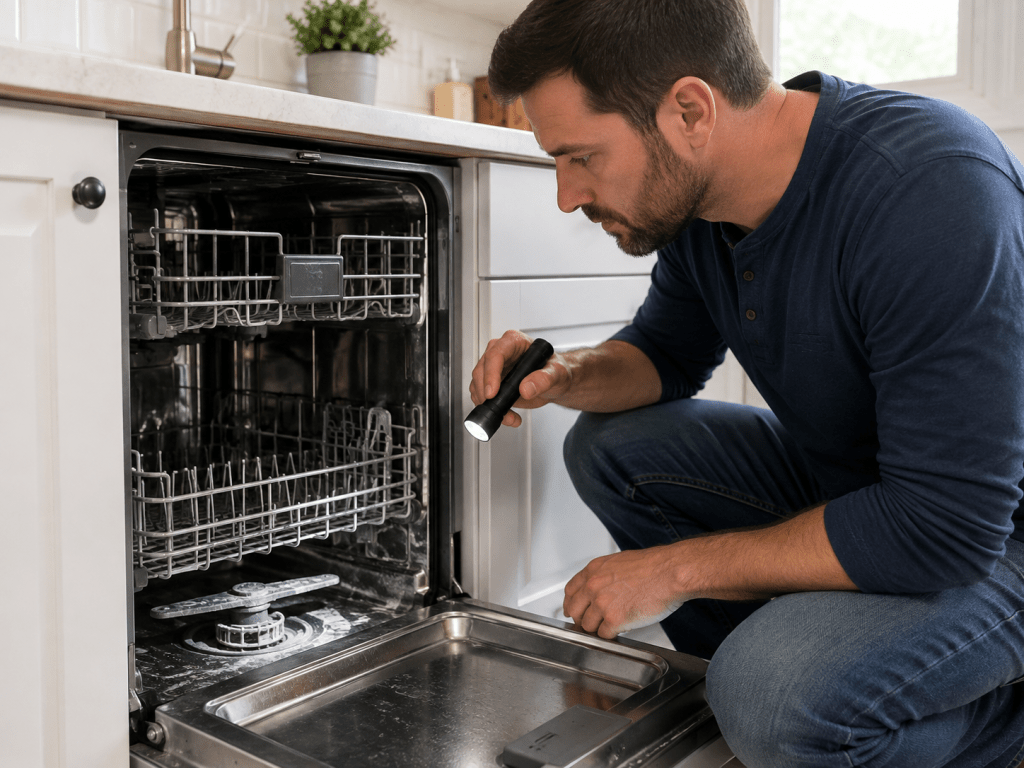
Begin with the visible surfaces. Inspect the dishwasher’s spray-arm openings, filter area, heating element, and stainless-steel walls. Look at the washer’s detergent drawer, door glass, rubber gasket, and hose connections. White or gray crust that returns after cleaning suggests mineral deposits rather than an isolated spill.
Test the household water with an inexpensive hardness strip. Follow the instructions carefully because dipping time and color-reading intervals matter. Test both hot and cold water if the kit allows it. The result will not identify every contaminant or plumbing issue, but it can confirm whether hardness deserves attention.
Check appliance temperatures and water flow. In the dishwasher, poor cleaning can result from water that is not warm enough, although excessively hot water creates its own risks. In the washer, compare hot- and cold-fill performance. A major difference may point to a clogged screen, restricted hose, or weak supply valve.
Review detergent use honestly. Are you filling the cap to the top for a medium load? Using two products that both contain detergent? Adding extra pods because the dishes or clothes looked dirty? Excess product is common, especially when concentrated formulas are involved.
Clean removable filters and spray arms according to the owner’s manual. Do not mix random household chemicals. Chlorine bleach and acidic cleaners can create dangerous fumes when combined. Bleach should also be kept away from certain stainless-steel components and incompatible appliance-cleaning products.
Check whether the appliance has a manufacturer-approved cleaning cycle. Use the recommended cleaner or descaling method. Vinegar is popular online, but repeated use of strong acid can affect some rubber parts, metal surfaces, adhesives, and finishes. A method that works for a coffee maker is not automatically appropriate for every washing machine or dishwasher.
Photograph heavy buildup before cleaning. If the problem returns quickly, the comparison helps you judge its severity. It also gives an appliance technician or water-treatment professional useful information.
These checks are meant to reveal patterns safely. They are not a substitute for opening pumps, testing live circuits, or dismantling heaters.
Protecting appliances from hard water requires a combination of water management, correct detergent use, routine cleaning, and early repair. There is no single bottle that solves every problem. A dishwasher cleaner can remove some deposits, but it cannot reopen a badly damaged valve. A water softener can reduce new scale, but it cannot repair a heater that has already failed.
Start with accurate information. Confirm water hardness and review the appliance manufacturer’s detergent recommendations. Some dishwasher and laundry detergent packages provide dosing guidance for different water conditions. Use those instructions as a starting point rather than relying on habit.
For dishwashers, keep the filter clean, make sure spray arms rotate freely, use rinse aid when appropriate, and avoid blocking detergent dispensers with large dishes. Scrape heavy food from plates, but do not assume aggressive pre-rinsing is always necessary. Some modern sensor-based machines perform better when they detect a normal amount of food soil.
For washers, use high-efficiency detergent when the machine requires it. Measure carefully. Leave the door or lid open after cycles when it is safe to do so, allowing moisture to escape. Remove clothing promptly, clean dispensers, and inspect the door gasket for trapped objects.
Address household plumbing issues. A corroded shutoff valve, restricted hose, or sediment-filled water heater can contribute to appliance problems. Replacing an appliance without correcting a poor water supply simply gives the same problem a new machine to attack.
Maintenance frequency should reflect actual conditions. A household with high mineral content, frequent hot cycles, pets, children, and daily laundry may need more attention than a one-person home running a few loads each week. Watch the machine rather than following a generic calendar blindly.
Most importantly, respond to performance changes early. A washer that begins filling slowly or a dishwasher that suddenly leaves residue is easier to correct before pumps, heaters, and controls become involved.
A sensible routine begins monthly. Inspect the dishwasher filter and remove trapped food according to the manual. Check the spray arms for visible deposits and confirm that they rotate without striking dishes or racks. Refill rinse aid when needed and wipe mineral residue from the door edges.
Run the dishwasher’s cleaning or maintenance cycle at the interval recommended by the manufacturer. Use a compatible dishwasher cleaner designed to address mineral deposits and grease. Do not combine the cleaner with bleach, detergent, vinegar, or another chemical unless the product instructions explicitly permit it.
For the washing machine, clean the detergent dispenser and door gasket regularly. Remove lint, hair, coins, and small objects. Run the washer-cleaning cycle with the approved product and leave the door open afterward so the interior can dry.
Every few months, inspect water-supply hoses and connections. Look for bulges, cracks, rust, moisture, and white crust around fittings. Make sure shutoff valves remain accessible. Do not wait for a leak to discover that the valve is frozen in the open position.
Compare fill times periodically. You do not need a stopwatch for every load, but a clear change deserves attention. If cold water enters quickly while hot water barely flows, the problem is likely on the hot side. Inspecting screens or valves may require turning off the water and following model-specific procedures.
Track detergent amounts. A small measuring cup or marked dispenser can prevent accidental overuse. Pods are convenient, but one pod may be too much for a small lightly soiled load, while heavily mineralized water may require a different detergent strategy. Product type, washer design, and water conditions all matter.
Once or twice a year, review the overall pattern. Are glasses clearer? Are towels softer? Has the washer odor improved? Do cycles finish normally? Maintenance should produce measurable benefits. If buildup returns rapidly despite correct care, household water treatment may be worth exploring. For additional maintenance tips, read our guide on how to extend the life of your washing machine.
A routine works because it prevents several thin layers from becoming one hard shell. Small, regular effort is far easier than dismantling a machine after years of neglect.
A traditional ion-exchange water softener removes calcium and magnesium by exchanging them for other ions, commonly sodium or potassium. This process can significantly reduce scale formation throughout the home. Dishwashers may use less detergent, glassware may look clearer, washers may rinse more effectively, and water-heating equipment may operate with less mineral stress.
A softener is not automatically the right solution for every Cleveland home. Installation cost, available space, drain access, salt use, maintenance, household plumbing, and actual hardness all matter. Some homeowners may prefer point-of-use treatment for a specific appliance, while others benefit from whole-house treatment.
Water conditioners are a broader category. Certain systems claim to change mineral behavior rather than remove hardness. Their effectiveness can vary depending on the technology and water chemistry. Homeowners should ask for clear performance data and understand whether the product truly reduces measured hardness or mainly aims to limit scale attachment.
Before installing any system, test the water. A professional water analysis can identify hardness and other factors that influence treatment. Avoid choosing equipment based only on a salesperson’s demonstration or visible residue. The system should be sized for household water usage and hardness level.
Softened water changes detergent requirements. Because detergent works more efficiently, the amount often needs to be reduced. Continuing to use hard-water detergent doses after installing a softener can produce excessive suds, residue, leaks, and poor rinsing. Dishwashers may also need rinse-aid and detergent adjustments.
Some people are concerned about sodium in softened water, while others dislike the feel of very soft water. Plumbing codes, health considerations, and local discharge requirements may influence the installation. A qualified water-treatment professional and plumber can explain appropriate options.
Think of water treatment as part of a larger strategy, not a magical shield. Filters need service, salt needs replenishment, and equipment must be maintained. Existing scale inside an appliance may still require cleaning or repair. Treatment helps prevent the next layer from forming; it does not erase the past overnight.
Call a professional when mineral buildup is accompanied by mechanical or electrical symptoms. A dishwasher that hums without circulating, repeatedly leaves water in the tub, fails to heat, trips a breaker, or displays persistent error codes needs more than surface cleaning. A washer that fills slowly despite strong household pressure, leaks from underneath, produces grinding sounds, or fails during heated cycles also deserves diagnosis.
Professional service is especially important when accessing the affected component requires removing panels. Dishwashers contain sharp metal edges, energized wiring, hot surfaces, pumps, and water connections. Washing machines are heavy and can release a surprising amount of water when hoses or filters are opened.
A technician should not simply point at visible scale and recommend every expensive part. Good diagnosis involves testing. The technician may verify fill volume, inlet-valve operation, heater resistance, pump current, drainage, sensor readings, water temperature, and error history. The goal is to determine which component failed and whether hard water contributed.
Ask whether the buildup can be cleaned or whether the part is permanently damaged. A lightly restricted spray arm may be recoverable. A heater with deep corrosion, a leaking pump seal, or a valve that no longer closes reliably may need replacement. The answer depends on condition, not wishful thinking.
The household water source may require another professional. If multiple fixtures have low flow, the hot-water supply is heavily restricted, or shutoff valves are corroded, a plumber should inspect the home. If a water-treatment system is being considered, choose a reputable specialist who can explain testing, sizing, maintenance, and expected results.
After the repair, ask how to prevent recurrence. You should leave the service call knowing the correct detergent type, cleaning routine, and any water-supply changes that matter. Replacing a part without changing the condition that damaged it is like putting a new tire on a car while leaving a bent wheel untouched.
The best repair restores the appliance and reduces the chance that hard water will create the same failure again.

Hard water can damage dishwashers and washing machines in Cleveland homes because dissolved minerals do not remain harmless forever. Repeated heating, evaporation, and detergent use turn those minerals into deposits. Scale narrows water passages, coats heating elements, interferes with sensors, reduces spray pressure, restricts inlet valves, and creates rough surfaces that make pumps and seals work harder.
The earliest symptoms often look cosmetic: cloudy glasses, white spots, stiff towels, dull clothing, and residue around dispensers. Those signs deserve attention because the same material may be collecting inside components that are far more expensive to replace. A dishwasher can continue running while its heater becomes insulated by scale. A washing machine can complete cycles while its inlet valve slowly loses flow.
Homeowners can reduce the damage by testing water hardness, using the correct amount of detergent, cleaning filters and dispensers, running approved maintenance cycles, monitoring fill performance, and addressing plumbing restrictions early. Rinse aid can improve dishwasher drying and spotting. Correct high-efficiency detergent dosing can reduce washer residue and odors. A properly selected water softener may make sense when hardness affects several appliances and fixtures throughout the home.
Avoid aggressive do-it-yourself chemistry. Mixing cleaners can create dangerous fumes, and repeated use of unapproved acids may damage rubber, metal, and finishes. Follow the appliance manual and use products designed for the machine.
When scale is paired with leaks, error codes, failed heating, weak circulation, slow filling, unusual noise, or electrical problems, professional repair is the safer choice. If you’re experiencing these symptoms in Northeast Ohio, learn more about our appliance repair services in Cleveland. A qualified technician can separate cleanable buildup from permanent component damage.
Hard water works slowly, which is exactly why it is easy to ignore. Treat the first chalky film as a warning rather than a personality quirk of the appliance. A little attention now can protect cleaning performance, reduce wasted energy, and help your dishwasher and washing machine last much longer.
We repair a wide range of household appliances including refrigerators, washers, dryers, ovens, dishwashers, and more. No matter the brand or model, our experienced technicians are ready to help. We repair commercial appliances as well: commercial washers dryers, commercial refrigerators & freezer & more.
We service a wide range of household appliances, including refrigerators, dryers, washers, ranges, cooktops, dishwashers, freezers, ice makers, ovens, and double ovens. Our technicians operate across many locations in Ohio, covering major cities like Cleveland, Akron, and Parma. We also serve surrounding areas including Lakewood, Westlake, Strongsville, and Brooklyn. Our service area extends to Rocky River, Euclid, Solon, Beachwood, and Cleveland Heights, as well as counties such as Cuyahoga, Lorain, Lake, and Medina. Additional cities we cover include North-Olmsted, North Ridgeville, Valley-City, Lorain, Avon Lake, Richfield, Brecksville, Garfield Heights, Seven Hills, Brunswick, Oakwood, Mentor, and Willoughby.