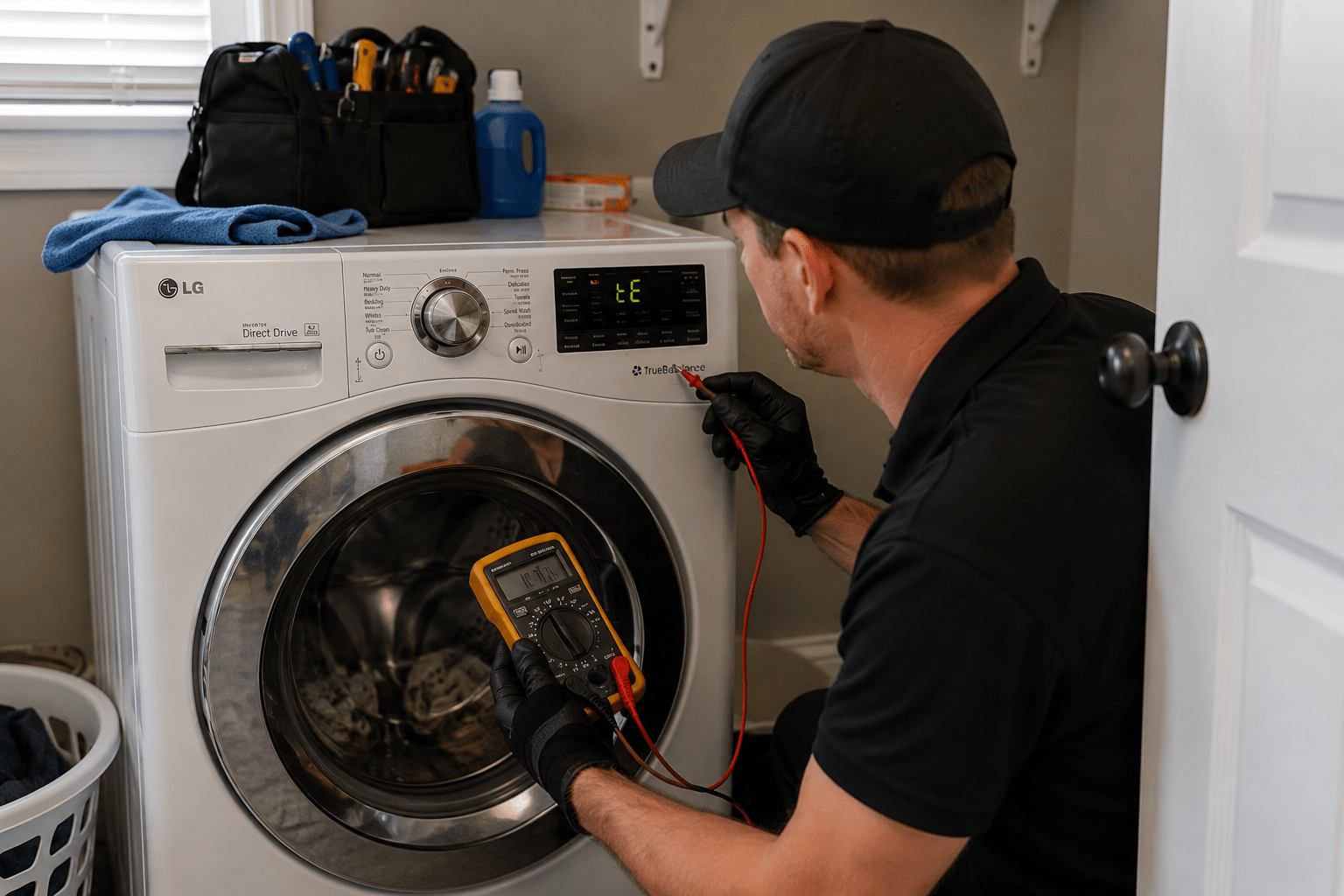
LG Washer tE Error Code
Published: July 27, 2026
Walk through an older Cleveland home and you can usually feel its history before anyone tells you the year it was built. The hardwood floors have a little movement, the basement walls tell stories through layers of paint, and the kitchen may have been remodeled more than once without ever being completely rebuilt. That character is exactly why people love homes in neighborhoods such as Ohio City, Tremont, Old Brooklyn, Collinwood, and West Park. Yet the same history that gives a house personality can make appliance repair more complicated than replacing a worn belt, a heating element, or a control board.
Modern appliances expect a fairly predictable environment. They are designed around stable voltage, correctly grounded outlets, reliable water pressure, open drain lines, level flooring, proper ventilation, and utility connections that meet current installation standards. An older home may deliver some of those conditions but not all of them, especially if electrical, plumbing, and gas systems were updated in stages. A refrigerator could be brand new while the circuit serving it was installed decades ago. A washer may have an advanced electronic control system but still drain into piping that was never designed for today’s high-flow pumps. When those two worlds meet, the appliance often gets blamed first.
That is why appliance repair in older Cleveland homes requires more than a quick symptom check. A qualified technician has to look at the appliance and the environment around it. The real question is not simply, “Which part failed?” It is also, “What caused that part to fail, and will the same condition damage the replacement?” That wider view can prevent repeat breakdowns, protect a homeowner’s investment, and uncover safety issues before they turn into expensive emergencies.
An appliance rarely operates in isolation. It depends on the house every minute it is running, even though that relationship is easy to overlook. A dishwasher needs the home to provide hot water at an appropriate pressure, accept wastewater quickly, and supply steady electricity. A dryer needs enough power or a safe gas connection, along with a vent path that lets hot, moist air escape. A refrigerator needs consistent voltage, adequate breathing room, and a reasonably stable surrounding temperature. When any supporting condition is weak, the appliance may begin acting like it has an internal defect.
This is where repair calls in older homes can become misleading. Imagine a homeowner whose washing machine repeatedly stops during the drain cycle. The obvious suspect is the drain pump, and sometimes the pump really is damaged. Yet a restricted standpipe, an undersized drain, or a partially blocked house line can force the pump to work harder than intended. Replacing the pump without recognizing the drainage problem is like buying new running shoes while ignoring the rock inside the old pair. The immediate symptom changes, but the source of the trouble remains.
Electronic controls make this relationship even more important. Many modern appliances use sensors and computer boards that respond to small variations in voltage, temperature, water flow, and airflow. Those components are precise, but precision can make them less forgiving. A mechanical washer from several decades ago might have continued operating through a minor voltage fluctuation. A modern machine may display an error code, pause unexpectedly, or shut down to protect itself.
Special repair attention means separating appliance failure from house-related stress. That process may involve testing voltage under load, inspecting connections, checking water flow, evaluating drainage, examining venting, and confirming that the appliance is installed correctly. The goal is not to make a repair visit unnecessarily complicated. The goal is to avoid solving only the visible half of the problem.
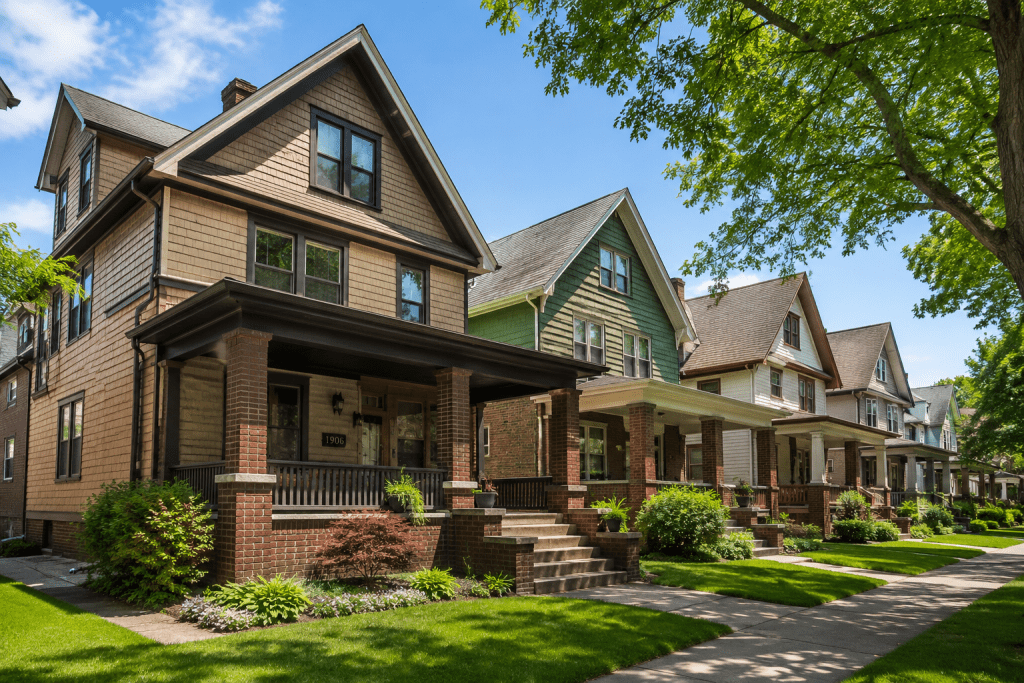
Cleveland has a wide variety of older homes, from compact bungalows and duplexes to larger brick houses and century-old properties with multiple additions. Many of these homes have been improved repeatedly, but renovations do not always happen as one coordinated project. One owner may replace the electrical panel. Another may remodel the kitchen without replacing every branch circuit. A later owner may move the laundry area, add a second refrigerator, or install a high-powered range. Each change can make sense on its own while creating a complicated network behind the walls.
That patchwork matters because appliance technicians do not always encounter one clearly “old” system or one fully modern system. They may find a new outlet connected to older wiring, modern plastic plumbing tied into aging metal pipe, or a recently installed gas appliance connected through an older shutoff arrangement. Visual appearance alone cannot confirm what is happening deeper in the system. A clean, remodeled room can still contain utility connections that deserve a closer look.
Cleveland’s climate adds another layer. Cold winters increase heating demands and can affect appliances located in basements, garages, enclosed porches, or poorly insulated additions. Humid periods can contribute to condensation and corrosion. Rapid temperature changes may influence water lines, drain behavior, and the performance of appliances operating near exterior walls. None of these conditions automatically causes a breakdown, but they can amplify weaknesses that already exist.
The smartest repair approach treats the home as part of the diagnostic picture. A technician should ask where the appliance is located, whether it has been moved, whether nearby renovations were completed, and whether the problem changes with the weather or with other equipment running. Those questions often reveal patterns. In an older Cleveland home, the history of the installation can be just as valuable as the model number printed on the appliance.
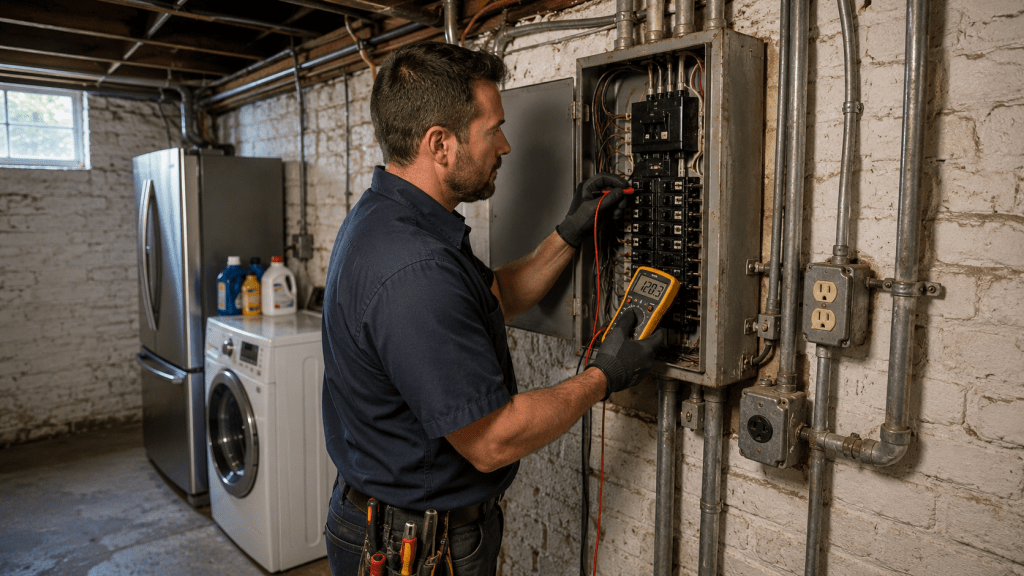
Older household electrical systems were built for a very different collection of equipment. Homes once relied on basic refrigerators, simple washing machines, modest lighting, and far fewer countertop devices. Today, a single kitchen may contain a refrigerator, dishwasher, microwave, garbage disposal, electric range, coffee maker, toaster oven, air fryer, and several chargers. The total demand is dramatically different, even when every appliance appears to work normally most of the time.
Modern appliances also use electronics that care about power quality, not just the presence of electricity. A control board needs stable voltage and sound connections. A motor needs enough current during startup. A heating element needs a circuit capable of carrying a sustained load without excessive resistance. When a connection is loose or a circuit is overloaded, the appliance may experience intermittent resets, weak performance, unexplained error codes, or premature component damage.
Learn more about the LG Washer tE Error Code and Whirlpool Washer F5E3 Error Code.
A refrigerator compressor that struggles to start may look like a sealed-system problem. A dryer that takes too long to heat may seem to need a new element. An oven that loses its display might be blamed on the control panel. Those diagnoses can be correct, but an experienced technician should also examine the electrical supply. Testing an outlet with no load is not always enough because some faults become visible only when the appliance begins drawing substantial current.
This does not mean every older home needs a complete electrical overhaul before an appliance can be repaired. It means the technician should avoid assumptions. The appliance may be the victim rather than the original cause. When repair work includes checking grounding, polarity, voltage stability, circuit condition, and connection quality, the homeowner receives a more complete answer—and a much lower chance of paying for the same failure twice.
Two-prong outlets remain common in some older homes, particularly in rooms that have not been fully updated. These receptacles do not provide the same equipment-grounding path expected by many modern appliances. Homeowners sometimes use adapters or extension cords to make a plug fit, but physical compatibility does not guarantee electrical safety. An appliance may power on while still lacking the protection its design assumes.
Shared circuits create another hidden problem. A refrigerator might share a line with basement lights, a microwave, a sump pump, or outlets in another room. Everything may appear fine until two devices start at the same moment. Then the voltage can dip, a breaker may trip, or the refrigerator’s electronics may reset. Because the event is brief, the homeowner may see only the aftermath: a flashing clock, partially thawed food, an error code, or a compressor that seems reluctant to restart.
Voltage irregularities can also result from aging receptacles, weak connections, damaged cords, questionable splices, or worn breakers. These problems often behave intermittently. The appliance works during the service visit, then fails again that evening. That is why the details provided by the homeowner matter. Does the display flicker when the microwave starts? Does the washer stop only when the furnace is running? Does the breaker feel warm or trip during a specific cycle? Patterns like these point beyond the appliance itself.
A responsible appliance technician should recognize when an electrical condition requires a licensed electrician. Appliance repair and household electrical work overlap diagnostically, but they are not interchangeable trades. The technician’s role is to test the supply, identify suspicious conditions, and explain whether the appliance can be safely repaired or operated. That boundary protects the homeowner while keeping the diagnosis honest. Special attention does not mean guessing outside one’s expertise; it means knowing exactly when another professional needs to be involved.
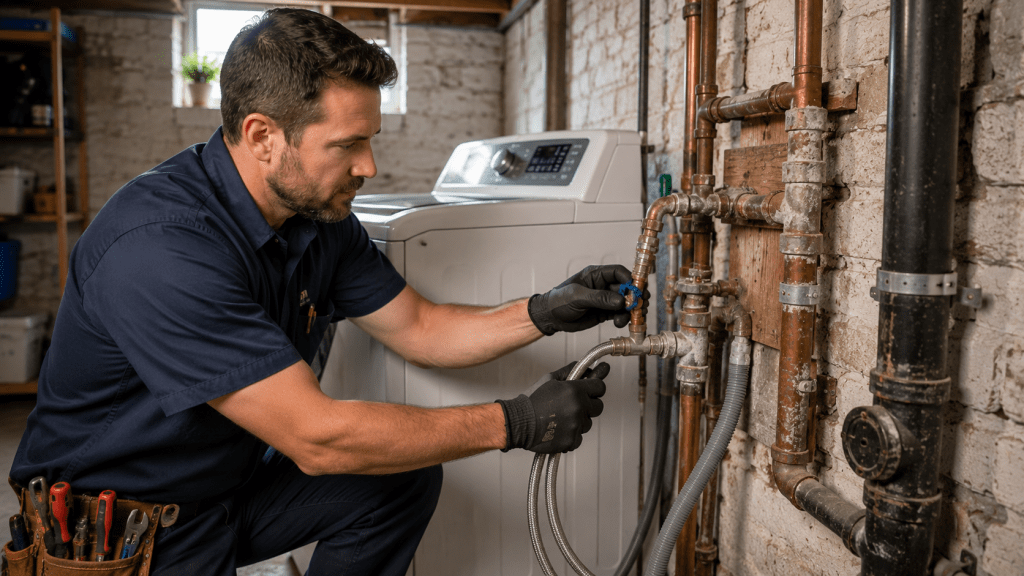
Water-using appliances are especially vulnerable to conditions created by older plumbing. A washing machine, dishwasher, refrigerator ice maker, and steam-equipped dryer all depend on predictable water delivery. When flow is slow, pressure fluctuates, valves are corroded, or sediment enters the appliance, performance can decline in ways that look like mechanical failure. The appliance may fill too slowly, stop mid-cycle, produce small ice cubes, leave detergent behind, or display a water-supply error.
Older shutoff valves are a common trouble spot. A valve may look open while internal corrosion prevents full flow. It may also begin leaking when a technician tries to close it, creating a repair risk that has nothing to do with the appliance. Supply hoses can be equally deceptive. A hose may appear intact on the outside while its internal lining has collapsed or become restricted. Small inlet screens inside washers and dishwashers can collect rust particles, mineral deposits, and debris released from household pipes.
Drainage introduces its own set of problems. Modern washers often move water quickly. If the home’s standpipe, trap, or branch line cannot handle that flow, water may back up, spill, or trigger a drain error. Dishwashers can suffer when the kitchen drain is partially restricted or when the drain hose is installed incorrectly after a remodeling project. The machine may leave water in the tub even though the pump itself is functioning.
The repair process should include flow and drainage checks before expensive parts are ordered. Technicians may inspect inlet screens, verify valve operation, observe filling behavior, and test how quickly water leaves the appliance. In an older Cleveland home, those simple steps can reveal that the machine is responding correctly to a plumbing limitation. Fixing the true restriction often restores performance without replacing a major appliance component.
Water pressure is not just about whether water comes out of the faucet. Appliances need sufficient flow during specific portions of their cycles. A washer may have only a limited amount of time to reach the required water level. A dishwasher may need a precise amount of water to circulate detergent and spray dishes effectively. When pressure is low or inconsistent, the machine may continue operating with too little water, producing poor results without an obvious leak.
Mineral buildup can make the situation worse. Deposits may form around inlet valves, screens, spray arms, ice-maker fill tubes, and heating surfaces. The effect is gradual, which is why homeowners often adapt without realizing it. Ice production gets slower. Glasses come out cloudy. The washer takes longer to fill. The dishwasher begins sounding different. By the time a service call is scheduled, several small restrictions may be working together.
Drainage restrictions behave in a similar way. A pipe does not have to be completely blocked to create trouble. A partial obstruction can slow wastewater just enough to confuse sensors or extend a cycle. In basement laundry rooms, old drain configurations may also allow water to back up when another fixture is used. The homeowner reports that the washer leaks “sometimes,” but the real trigger may be a nearby sink, floor drain, or utility pump.
A thorough diagnosis looks for cause and effect. The technician should determine whether the appliance is asking for water correctly, whether water is arriving at the expected rate, and whether it is leaving without resistance. Replacing a fill valve will not repair low household pressure. Installing a new drain pump will not clear a restricted branch line. The best service call connects the appliance symptom to the physical condition producing it, saving the homeowner from a cycle of repeat appointments and unnecessary parts.
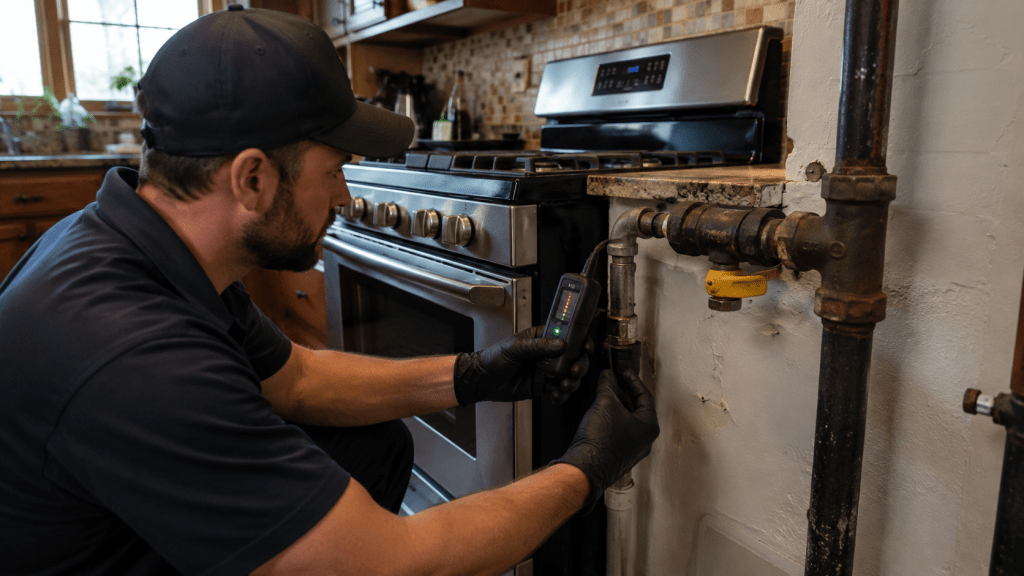
Gas appliances demand a careful approach in any home, but older properties can present additional variables. A range or dryer may have been replaced several times while the shutoff valve, connector location, or surrounding piping remained unchanged. Renovations may have altered cabinets, flooring, or wall surfaces without improving access to the gas connection. What appears to be a straightforward repair can become complicated the moment the appliance is moved.
Combustion problems can also imitate appliance defects. A gas dryer that takes too long to dry may have weak burner performance, but restricted venting, poor airflow, or an inadequate gas supply can create similar symptoms. A range burner that lights unevenly could have a dirty burner head, an ignition issue, incorrect assembly, or a supply-related concern. The technician has to observe the full ignition sequence instead of replacing the first component associated with the symptom.
Any odor of gas changes the situation immediately. The appliance should not be treated as a normal repair project until the source has been addressed safely. Homeowners should avoid operating switches, creating flames, or continuing to test the appliance themselves. Gas leaks and combustion concerns require proper procedures, suitable detection equipment, and clear coordination with the gas utility or an appropriately licensed professional when needed.
Specialized attention also includes checking whether the appliance was installed for the correct fuel type. Natural gas and propane appliances use different configurations, and incorrect conversion can cause poor combustion or unsafe operation. Although propane is less common in Cleveland’s urban neighborhoods, technicians should still verify rather than assume. With gas equipment, details matter. A good repair does more than restore heat; it confirms that ignition, flame quality, connections, and airflow are all behaving as intended.
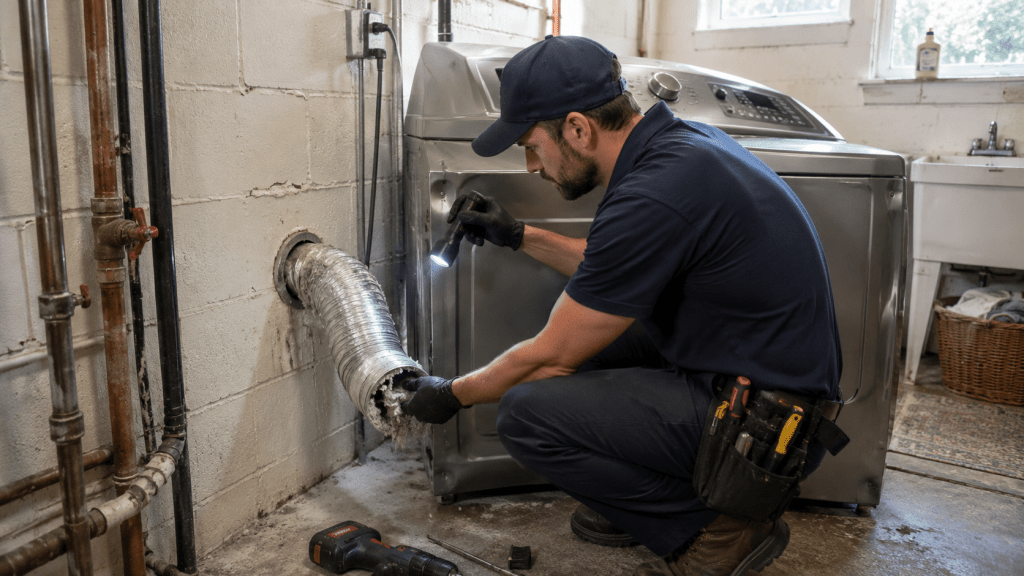
Airflow is one of the most overlooked factors in appliance performance. Refrigerators release heat through condenser systems. Dryers need to expel large amounts of hot, moist air. Range hoods are supposed to remove cooking heat, grease, and humidity. Even built-in ovens and dishwashers depend on installation clearances that help them manage heat. When an older home has tight cabinetry, enclosed utility areas, or outdated vent paths, appliances may run hotter and longer than they should.
Dryer venting is the clearest example. In many older homes, laundry spaces were added after the original construction. The dryer may be far from an exterior wall, forcing the vent to travel through turns, joist spaces, or long basement runs. Every bend adds resistance, and lint buildup makes the problem worse. The dryer keeps heating, but moisture cannot escape efficiently. Clothes remain damp, cycles become longer, internal temperatures rise, and safety risks increase.
Refrigerators can face similar stress when they are squeezed into openings designed for smaller models. A modern refrigerator may technically fit between the cabinets while lacking adequate space for heat to escape. Dust, pet hair, and kitchen grease can coat accessible condenser areas, forcing the compressor to run more frequently. The owner hears the machine running all day and assumes the compressor is failing, when poor ventilation may be a major contributor.
Repair technicians should evaluate the air path, not just the powered components. Is the dryer vent crushed behind the machine? Does it terminate outdoors? Is the flap opening properly? Does the refrigerator have the required clearance? Is an oven’s cooling fan moving air freely? These questions help explain why a seemingly minor installation issue can destroy expensive parts over time. Good airflow is not an optional comfort feature. It is part of the appliance’s operating system.
Basements are a practical place for laundry equipment, freezers, second refrigerators, and utility sinks. In Cleveland homes, however, basement conditions can differ sharply from the clean, climate-controlled environments appliance manufacturers typically picture. Concrete floors may slope toward drains. Temperatures may change with the seasons. Humidity can rise after heavy rain. Walls and pipes may release moisture, and older windows may provide only limited ventilation.
These conditions affect appliances in subtle ways. A washing machine sitting on an uneven floor may shake violently during the spin cycle. A freezer placed near a damp wall may develop corrosion around its cabinet or electrical connections. A dryer operating in a cool, humid room may take longer to manage moisture, especially when its venting is already restricted. The appliance can still function, but it is working under constant environmental stress.
Basement access matters too. Narrow stairways, low ceilings, tight doorways, and fixed plumbing can make it difficult to move an appliance safely. A technician may not be able to pull a washer straight forward because the utility sink blocks the path. A dryer may be installed beneath pipes or ductwork, leaving little room to remove the top panel. Repair planning has to account for these physical limitations before disassembly begins.
Homeowners can help by describing the space when scheduling service. Mentioning stacked equipment, narrow stairs, built-in counters, standing water, or difficult shutoff access allows the technician to arrive better prepared. Special repair attention is not only about technical diagnosis. It also includes protecting floors, preventing water damage, moving heavy machines safely, and making sure the appliance can be returned to its position without crushing hoses, cords, or vents.
Moisture damage rarely announces itself with one dramatic event. It usually develops slowly. A humid basement may create condensation on cool metal surfaces, especially during seasonal temperature changes. Small amounts of moisture can reach wire terminals, cabinet seams, motor housings, and control compartments. The appliance may continue operating for months while corrosion gradually increases electrical resistance or weakens connections.
This is one reason intermittent problems are so common in damp locations. A washer may work normally during dry weather but display errors after several humid days. A freezer may trip a ground-fault-protected outlet only under certain conditions. A dryer’s metal panels may show rust near the floor even though no active leak is visible. Those symptoms are easy to dismiss because they do not occur consistently.
Water intrusion can come from more than humidity. Basement seepage, sweating pipes, leaking utility sinks, floor-drain backups, and tiny supply-hose leaks all create damaging conditions. The source may be several feet away from the appliance. Water follows slopes, seams, and low points, so the wet area around a machine does not always reveal where the problem began.
A technician working in this environment should inspect for corrosion, mineral tracks, rust patterns, damaged connectors, and evidence of previous water exposure. Simply drying a component may not restore a reliable connection. Corroded terminals can continue heating under load, while moisture-damaged control boards may behave unpredictably. Homeowners should also address the room itself through drainage improvements, leak repair, ventilation, or dehumidification. Replacing an appliance without improving persistent moisture is like putting a new book on a wet shelf. The book may be perfect, but the environment is already working against it.
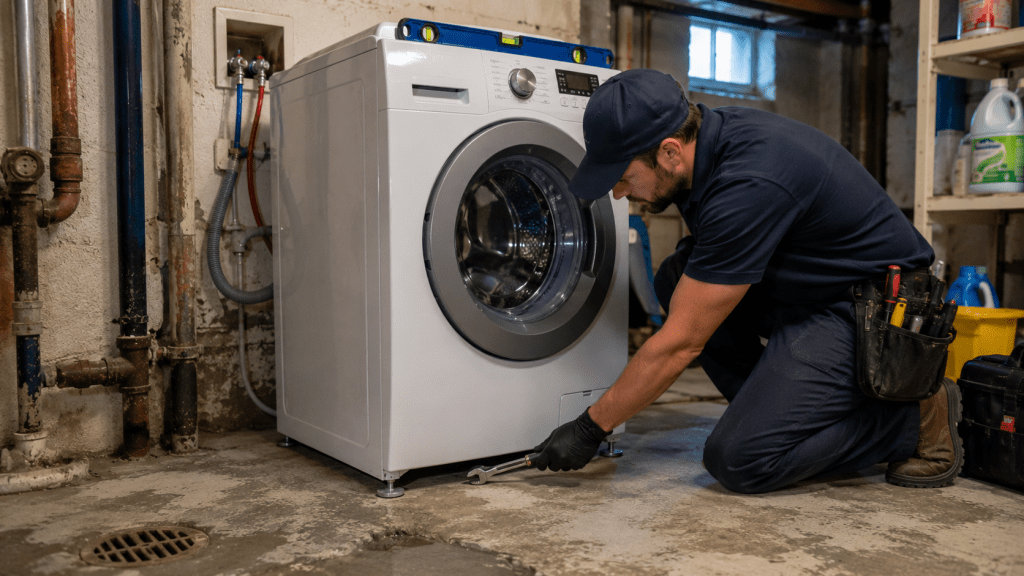
Older floors are rarely perfectly level, especially in basements, kitchens with multiple flooring layers, and rooms that have settled over time. That does not automatically make the home unsafe, but it can interfere with appliance operation. Washers are particularly sensitive because high-speed spin cycles create strong forces. When the cabinet is not level or all four feet are not firmly supported, the machine may walk, bang, vibrate, or stop the cycle.
Homeowners often assume severe shaking means a suspension failure. Sometimes it does. Yet the first step should be confirming that the machine is level, the shipping materials were removed, and the floor can support the load without flexing. A perfectly repaired washer will still perform poorly if it rocks on an uneven surface. The same principle applies to refrigerators, which need proper leveling for door alignment, drainage, and stable compressor operation.
Tight spaces add another layer of risk. Appliances may be wedged between cabinets, walls, pipes, or countertops with almost no service clearance. Hoses can kink when the machine is pushed back. Power cords can become pinched. Dryer vents may collapse behind the cabinet. Refrigerator water lines may bend sharply and develop slow leaks. The appliance looks neatly installed from the front while critical connections are under stress behind it.
A careful technician should inspect the installation after completing the repair, not simply slide the machine back into place. That means confirming that hoses remain open, cords are protected, vents are not crushed, and the appliance stays level. In especially restrictive spaces, the homeowner may need minor carpentry, plumbing, or installation changes before reliable operation is possible. The objective is not just to make the appliance run during the appointment. It is to leave it in a position where it can continue running safely after the technician leaves.
Some appliances are more sensitive than others to the conditions found in older homes. Water-using machines respond quickly to plumbing restrictions. Heating appliances are affected by electrical capacity, gas supply, and ventilation. Refrigerators depend heavily on airflow and stable power. Understanding those relationships helps homeowners describe symptoms more accurately and gives technicians a better starting point.
The table below shows several common examples:
| Appliance | Home-Related Condition | Possible Symptom | Why Diagnosis Can Be Misleading |
| Refrigerator | Shared circuit or poor ventilation | Warm temperatures, clicking, frequent cycling | Compressor failure may be suspected first |
| Washing machine | Restricted drain or uneven floor | Drain errors, shaking, incomplete cycles | Pump or suspension may be blamed |
| Dryer | Long or crushed vent | Long drying times, overheating, shutdowns | Heating element or gas valve may seem defective |
| Dishwasher | Low flow or restricted kitchen drain | Dirty dishes, standing water, error codes | Fill valve or drain pump may be replaced unnecessarily |
| Range or oven | Voltage or gas-supply issue | Slow heating, failed ignition, temperature swings | Controls or igniters may not be the original cause |
This comparison is not a substitute for diagnosis. It is a reminder that similar symptoms can come from very different sources. A refrigerator that clicks may have a failing start device, a damaged compressor, low voltage, or several problems at once. A dishwasher with standing water could have a blocked filter, a failed pump, a pinched hose, or a slow household drain.
Specialized repair means testing possibilities in a logical order. The technician should begin with accessible, high-probability causes, verify utility conditions, and use model-specific service information where appropriate. That process protects the homeowner from expensive guesswork and gives the repaired appliance a better chance of lasting.
Refrigerators have changed dramatically in size, complexity, and installation requirements. Older kitchens were often designed around narrower, shallower models with basic cooling systems. A modern French-door refrigerator may be taller, deeper, and packed with electronics, multiple fans, variable-speed compressors, water valves, sensors, and display boards. Fitting that machine into an older kitchen opening can create airflow and access problems even when the measurements appear acceptable.
Heat is the central issue. A refrigerator does not create cold; it moves heat from inside the cabinet to the surrounding room. If the top, back, or sides are boxed in too tightly, that heat remains near the appliance. The condenser system works harder, operating temperatures rise, and the compressor may run for long periods. Dirty coils or blocked toe-kick vents can intensify the problem.
Electrical conditions matter as well. Refrigerators cycle automatically around the clock, and their compressors require a surge of current at startup. A weak receptacle, shared circuit, or intermittent connection can cause clicking, control resets, or failed starts. Because the appliance may restart later, homeowners sometimes believe the problem has disappeared. In reality, each difficult start can place additional stress on electrical and mechanical components.
Water lines deserve attention on models with ice makers and dispensers. Older saddle valves, brittle tubing, weak shutoffs, and improvised routing can cause low flow or hidden leaks. A refrigerator repair may solve an ice-maker problem while revealing that the household connection also needs professional plumbing work.
A good technician evaluates temperature history, airflow, compressor behavior, fan operation, door sealing, voltage, and installation clearance together. Replacing a control board without addressing heat or power instability is unlikely to produce a lasting result. Refrigerators are expensive, central to daily life, and highly sensitive to their surroundings, making a complete diagnosis especially valuable.
Basement laundry rooms combine several risk factors in one place: water, electricity, gas, humidity, drainage, vibration, and restricted access. A washer may sit beside a utility sink beneath exposed pipes, while the dryer vents through a long route to an exterior wall. Each part of that arrangement affects performance. When a problem develops, it is easy to focus on the machine while missing the room’s contribution.
Washers need stable flooring, strong water flow, open drainage, and correctly positioned hoses. An uneven concrete floor can create violent spin behavior. A partially closed valve can trigger slow-fill errors. A standpipe that is too short, too narrow, or restricted can lead to overflow or siphoning. If the drain hose is inserted incorrectly, water may flow back into the tub or leave the machine during filling.
Dryers depend on airflow more than many homeowners realize. The machine can generate plenty of heat and still fail to dry clothes when moisture cannot escape. Long vent runs, excessive bends, flexible duct material, crushed sections, and lint accumulation all reduce performance. Replacing thermostats or heating components without measuring airflow can lead to repeated failures.
Gas dryers add combustion considerations, while electric dryers require a high-capacity circuit and correct voltage across both power legs. A dryer can tumble normally with only part of its electrical supply present, yet produce little or no heat. That symptom looks like a failed heating element until the incoming power is tested correctly.
Special attention means inspecting the entire laundry setup. The technician should confirm water flow, drainage, leveling, vent condition, electrical supply, gas operation when applicable, and safe access. In older Cleveland basements, the room itself often provides half the diagnosis.
Kitchens in older homes are frequently renovated in layers. Cabinets may have been installed over previous flooring, countertops may have been replaced without moving utility connections, and appliances may occupy spaces that were originally intended for different equipment. These modifications can create unusual service challenges for ranges, ovens, and dishwashers.
A dishwasher may be trapped by flooring installed in front of it. The machine appears removable, but its leveling feet sit below the finished floor height. Pulling it out can damage the countertop, flooring, door, or water connection. Even when access is possible, the shutoff valve may be hidden deep inside a cabinet or shared with the kitchen faucet. A small repair can quickly become a plumbing project if that valve no longer closes reliably.
Ranges face similar access issues. Anti-tip hardware, gas connectors, electrical cords, and rigid flooring transitions all affect how safely the appliance can be moved. A range that has been pushed tightly against a wall may have a crushed cord or stressed gas connector behind it. Built-in ovens require even more planning because surrounding cabinets must support the unit while allowing ventilation and service access.
Performance problems can also come from the installation. A dishwasher tilted forward may leak around the door. A range on an uneven floor may cause pans to sit incorrectly and liquids to cook unevenly. An oven with blocked ventilation may overheat electronic controls. Cabinet modifications can cover vents that manufacturers intended to remain open.
Experienced technicians approach modified kitchens slowly. They identify shutoffs, protect finished surfaces, check clearances, and determine whether the appliance can be removed without damage. That caution may look less dramatic than immediately opening a toolbox, but it is part of professional repair. In an older home, gaining safe access can be as important as replacing the failed part.
Specialized repair does not mean turning every service call into a major renovation. It means using a broader diagnostic process before reaching a conclusion. The technician begins with the homeowner’s description, verifies the symptom, reviews error codes, and tests the appliance. At the same time, the technician observes the installation, utility connections, room conditions, and signs of previous work.
That process should be evidence-based. Parts should not be replaced simply because they are commonly associated with a symptom. A no-heat dryer needs electrical or gas testing, airflow evaluation, temperature measurements, and component checks. A refrigerator that is not cooling needs airflow, temperature, frost-pattern, fan, compressor, and voltage evaluation. A washer that will not drain needs inspection of the pump system and the household drain path.
Communication is another major part of specialized service. The homeowner should understand which problem belongs to the appliance and which condition belongs to the house. For example, a technician might explain that the dryer’s thermal fuse failed, but the restricted vent likely caused the overheating. Both issues must be addressed. That explanation gives the homeowner a clear path instead of a mysterious invoice.
A strong repair visit also includes practical prevention. The technician may recommend improving clearance, replacing a damaged hose, cleaning a vent, stabilizing the machine, using a dedicated circuit, or consulting an electrician or plumber. These recommendations should be specific, not vague attempts to sell unrelated work.
The result is a repair that addresses the entire failure chain. The appliance is restored, the contributing condition is identified, and the homeowner knows what to do next. That is the difference between changing a part and solving a problem.
The best technician for an older home is not necessarily the person who offers the lowest diagnostic fee or promises an instant answer over the phone. Look for someone who asks questions about the appliance’s location, utility type, installation, error codes, and history. Those questions indicate that the technician understands how much context matters.
Experience with older properties is valuable because access problems and mixed utility systems can surprise technicians who are accustomed to newer construction. A qualified professional should be comfortable testing appliance power supplies, recognizing unsafe connections, evaluating water flow, and identifying vent restrictions. Just as important, the technician should know when to stop and refer the homeowner to a licensed electrician, plumber, HVAC contractor, or gas professional.
Ask how the company handles diagnosis and estimates. A clear estimate should separate the known failure from any additional condition discovered during service. The technician should explain whether a repair is likely to be durable or whether the appliance has multiple age-related problems. Honest advice sometimes means recommending replacement, but that recommendation should be based on condition, repair cost, parts availability, and expected reliability—not pressure.
Homeowners should also pay attention to communication and care inside the house. Does the technician protect flooring, inspect connections before moving the appliance, and test the machine after reinstallation? Does the explanation make sense without relying on technical intimidation? Are safety concerns described clearly?
Older Cleveland homes reward technicians who are patient, observant, and methodical. The right professional does not treat the house as an inconvenience. They recognize it as part of the system. That mindset leads to safer repairs, fewer repeat failures, and better decisions about whether to fix, modify, or replace an appliance.
Appliances in older Cleveland homes often require special repair attention because the machine and the house are working as one connected system. Electrical circuits, plumbing lines, gas connections, ventilation paths, basement conditions, flooring, and installation clearances all influence appliance performance. A failure that appears to be internal may begin with an external condition the appliance cannot control.
That does not mean owning an older home requires constant appliance trouble. Many older properties support modern equipment perfectly well after thoughtful updates and proper installation. The challenge is avoiding assumptions. A remodeled kitchen may still have an aging drain connection. A modern laundry room may still use a long dryer vent. A new refrigerator may still be operating on a crowded circuit or inside an opening with limited airflow.
The most effective repair process asks two questions: What failed inside the appliance, and what conditions contributed to that failure? Answering both provides far more value than changing a part and hoping the symptom stays away. It also helps homeowners prioritize improvements. Sometimes the solution is a simple adjustment. In other cases, an electrician, plumber, or ventilation specialist may need to correct the supporting system.
Older Cleveland homes have personality, craftsmanship, and history that newer buildings cannot easily imitate. Their appliances simply need technicians who understand that history and know how to work with it. With careful diagnosis, clear communication, and attention to the surrounding environment, homeowners can protect their equipment without sacrificing the character that made them fall in love with the house in the first place.
We repair a wide range of household appliances including refrigerators, washers, dryers, ovens, dishwashers, and more. No matter the brand or model, our experienced technicians are ready to help. We repair commercial appliances as well: commercial washers dryers, commercial refrigerators & freezer & more.
We service a wide range of household appliances, including refrigerators, dryers, washers, ranges, cooktops, dishwashers, freezers, ice makers, ovens, and double ovens. Our technicians operate across many locations in Ohio, covering major cities like Cleveland, Akron, and Parma. We also serve surrounding areas including Lakewood, Westlake, Strongsville, and Brooklyn. Our service area extends to Rocky River, Euclid, Solon, Beachwood, and Cleveland Heights, as well as counties such as Cuyahoga, Lorain, Lake, and Medina. Additional cities we cover include North-Olmsted, North Ridgeville, Valley-City, Lorain, Avon Lake, Richfield, Brecksville, Garfield Heights, Seven Hills, Brunswick, Oakwood, Mentor, and Willoughby.


